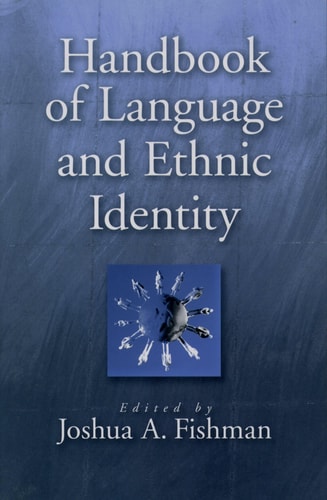
Handbook of Language and Ethnic Identity: The Success-Failure Continuum in Language and Ethnic Identity Efforts
0
0
As an Amazon Associate and affiliate partner, Menrva Books earns from qualifying purchases. Learn more
Author Description
Like the first volume, The Handbook of Language and Ethnic Identity, Volume 2 is a reference work on the interconnection between language and ethnic identity. In this volume, 37 new essays provide a systematic look at different language and ethnic identity efforts, assess their relative successes and failures, and place the cases on a success-failure continuum. The reasons for these failures and successes and the linguistic, social, and political contexts involved are subtle and highly complex. Some of these factors have to do with whether the language is considered a dialect, as in the cases of Bavarian, Ebonics, and Scots (considered to be dialects of German, American English, and British English, respectively). Other factors have to do with government policy, as in the cases of Basque and Navajo. Still other factors are historical, such as the way Canaanite was supplanted in present-day Israel by another classical language-Hebrew.Although the volume offers considerable sophistication in the treatment of language, ethnicity and identity, it has been written for the non-specialized reader, whether student or layperson. The contributors are an international group of well-known scholars in a range of fields. Fishman and García provide a detailed introduction that addresses the difficulty of assessing the success or failure of a language. They also present a conclusion that integrates the data presented in the volume.
Menrva's Summary
THE THESIS
This volume investigates the complex factors that determine the success or failure of efforts to maintain or revitalize language within the context of ethnic identity. Editors Joshua Fishman and Ofelia García, both prominent scholars in the field of sociolinguistics, curate a collection of 37 essays that examine specific case studies across a global spectrum. The work argues that linguistic survival is rarely a matter of simple effort, but rather a result of intricate interactions between government policy, historical precedent, and the social perception of a language as either a distinct entity or a dialect.
THE SCOPE MAP
What You Will Find
- A comparative analysis of language efforts including Basque, Navajo, Bavarian, Ebonics, and Scots.
- A theoretical framework for evaluating the success-failure continuum in language planning.
- Case studies detailing the impact of political and social contexts on linguistic identity.
- An integrated conclusion that synthesizes the diverse data points provided by international contributors.
THE AUTHORITY PERSPECTIVE
Experts recognize this volume as a significant reference work that bridges the gap between academic sociolinguistics and accessible analysis for students. Readers frequently note that while the subject matter is highly complex, the editors successfully maintain a tone that remains approachable for the non-specialized reader.
Page Count:
512
Publication Date:
2011-04-13
Publisher:
Oxford University Press
ISBN-10:
0195392450
ISBN-13:
9780195392456
Ethnicity
Reference
Sociology
Ethnic Studies
Linguistics
Anthropological linguistics
Language And Culture