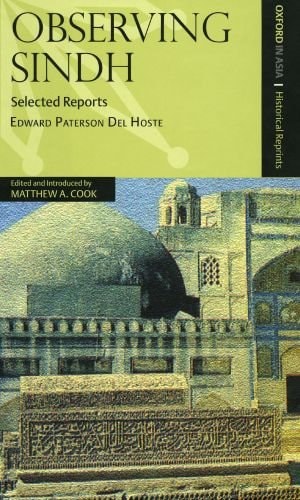
Observing Sindh: Selected Reports
0
0
As an Amazon Associate and affiliate partner, Menrva Books earns from qualifying purchases. Learn more
Author Description
During the first half of the nineteenth century the British quadrupled the size of their empire in South Asia. This break from pre-British to British South Asia resulted, in part, from superior arms, military organization and economic wealth. This process also relied on a liaison between knowledge and power: studying the lives and lands of would-be subjects usually pre-dated specific imperial expansions. To this end, Edward Patterson Del Hoste travelled to Sindh in 1831.A member of Henry Pottingers 1831-32 diplomatic mission to Hyderabad and Khyrpoor (now Khairpur), Del Hoste was a surveyor. He not only surveyed the villages and towns that the mission travelled through, but commented extensively on Sindhs human and physical geography. Part of a larger attempt to counteract Russian imperialism by opening the Indus River to free trade, Del Hostes surveys and comments were subsequently submitted as two reports to the Bombay Presidency. The main aim of the reports was to help the British establish a more commanding presence in Sindh by expanding their knowledge about the Indus region and those who lived in it.This new Oxford edition reprints Del Hostes 1932 reports. It differs from previous reprints by using manuscripts to restore original grammar, maps and diagrams. It also supplements the 1832 reports with two subsequent ones by Del Hoste. Submitted to the Bombay Presidency in 1839, these were last reprinted in 1855.
Menrva's Summary
THE THESIS
This collection investigates how the systematic gathering of geographical and social data served as a foundational tool for British imperial expansion in Sindh during the nineteenth century. Edward P. Del Hoste, a surveyor attached to the 1831-32 diplomatic mission to Hyderabad and Khairpur, produced detailed reports that bridged the gap between military intelligence and colonial administration. By analyzing these primary documents, the text illustrates the strategic intersection of cartography, trade interests, and the geopolitical objective of countering Russian influence in the Indus region.
THE SCOPE MAP
What You Will Find
- Detailed geographical and human surveys of Sindh from the 1830s.
- Primary source reports submitted to the Bombay Presidency in 1832 and 1839.
- Restored original maps, diagrams, and corrected manuscript grammar.
- Contextual analysis regarding the British effort to open the Indus River for free trade.
THE AUTHORITY PERSPECTIVE
Historians and researchers value this edition for its restoration of original manuscripts and inclusion of previously difficult-to-access 1839 reports. Scholars frequently cite the work as a critical primary source for understanding the mechanics of colonial knowledge production in South Asia.
Page Count:
138
Publication Date:
2008-12-15
Publisher:
Oxford University Press
ISBN-10:
019547287X
ISBN-13:
9780195472875
History
Geography
Colonialism
Military History
India - History
Travelogue
Great Britain
South Asia
Community Tags
Similar Books