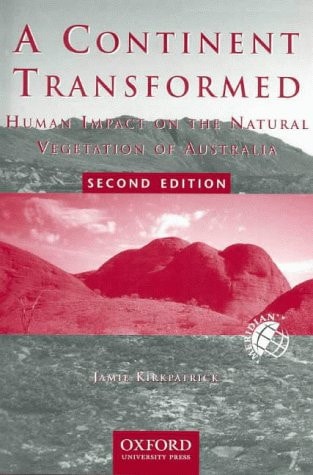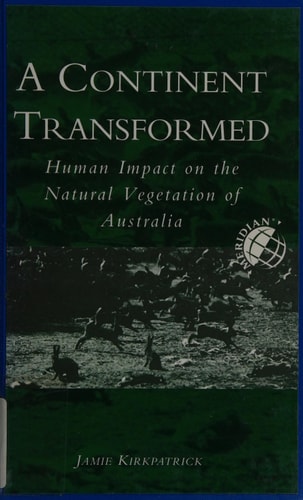
A Continent Transformed: Human Impact on the Natural Vegetation of Australia
0
0
As an Amazon Associate and affiliate partner, Menrva Books earns from qualifying purchases. Learn more
Author Description
When hunters and gatherers arrived in Australia many tens of thousands of years ago, their burning, hunting, and vegetable gathering practices caused substantial change in the continent's vegetation. In the last two centuries, European settlers have greatly accelerated the process, sometimes wiping out entire vegetation types as they clear vast areas for farms, forest plantations, houses, and roads. They continue to alter the nature of the remaining forests though the removal of wood, and their introduction to the region of new animal and plant species has dramatically changed large areas of the surviving bush. A Continent Transformed provides a succinct, accessible introduction to the biogeography of Australia, focusing in particular on the changes that have occurred and offering practical solutions for saving the continent's remarkable biological diversity. Written for people approaching the subject for the first time, the book highlights the latest scientific research on ecological issues in non-technical terms. Students of biogeography and ecology--indeed all those interested in the conservation of Australia's magnificent natural heritage--will find A Continent Transformed interesting, enlightening, and stimulating.
Menrva's Summary
THE THESIS
This book investigates the historical and contemporary impact of human activity on the natural vegetation of the Australian continent. Author Jamie Kirkpatrick, a noted expert in biogeography, synthesizes decades of ecological research to explain how indigenous land management and subsequent European colonization have fundamentally altered Australian ecosystems. The text provides a framework for understanding these shifts while proposing evidence-based strategies to preserve the continent's remaining biological diversity.
THE SCOPE MAP
What You Will Find
- Historical analysis of pre-colonial indigenous land management practices.
- Evaluation of European agricultural and urban expansion impacts on native flora.
- Examination of the ecological consequences of introduced plant and animal species.
- Practical conservation methodologies for protecting Australian biodiversity.
THE AUTHORITY PERSPECTIVE
Experts and educators frequently cite this work as a highly accessible entry point for students and laypeople interested in Australian environmental history. The text is praised for its ability to distill complex ecological data into clear, non-technical language without sacrificing scientific rigor.
Page Count:
144
Publication Date:
1995-01-19
Publisher:
Oxford University Press
ISBN-10:
0195534735
ISBN-13:
9780195534733
Science
Ecology
Conservation
Australia
Biogeography
Botany