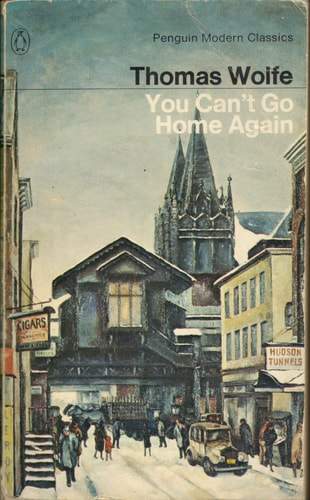
You Can't Go Home Again
0
0
As an Amazon Associate and affiliate partner, Menrva Books earns from qualifying purchases. Learn more
Author Description
Now available from Thomas Wolfe’s original publisher, the final novel by the literary legend, that “will stand apart from everything else that he wrote” (The New York Times Book Review)—first published in 1940 and long considered a classic of twentieth century literature.With an Introduction by Gail GodwinA twentieth-century classic, Thomas Wolfe’s magnificent novel is both the story of a young writer longing to make his mark upon the world and a sweeping portrait of America and Europe from the Great Depression through the years leading up to World War II. Upon the publication ofYou Can’t Go Home Again in 1940, two years after Wolfe’s death,The New York Times Book Review declared that it “will stand apart from everything else that he wrote because this is the book of a man who had come to terms with himself, who was on his way to mastery of his art, who had something profoundly important to say.”Driven by dreams of literary success, George Webber has left his provincial hometown to make his name as a writer in New York City. When his first novel is published, it brings him the fame he has sought, but it also brings the censure of his neighbors back home, who are outraged by his depiction of them. Unsettled by their reaction and unsure of himself and his future, Webber begins a search for a greater understanding of his artistic identity that takes him deep into New York’s hectic social whirl; to London with an uninhibited group of expatriates; and to Berlin, lying cold and sinister under Hitler’s shadow. He discovers a world plagued by political uncertainty and on the brink of transformation, yet he finds within himself the capacity to meet it with optimism and a renewed love for his birthplace. He is a changed man yet a hopeful one, awake to the knowledge that one can never fully “go back home to your family, back home to your childhood... away from all the strife and conflict of the world... back home to the old forms and systems of things which
Menrva's Summary
THE PULSE
After achieving literary success with his debut novel, George Webber faces the harsh realization that his artistic truth has alienated him from his roots and his hometown. Driven by a desire to define his identity as a writer, Webber navigates the complex social landscapes of New York, London, and Berlin. He encounters the mounting political tensions of the pre-World War II era, which force him to confront the fragility of his own ideals. The narrative follows his internal development as he moves from the provincial expectations of his past toward a broader, more mature understanding of his place in a rapidly changing global society. This work utilizes a reflective, semi-autobiographical framework to examine the tension between individual ambition and the collective history of a nation.
INSIDE THE PAGES
- Semi-autobiographical narrative structure
- Expansive, descriptive prose style
- Exploration of the expatriate experience in Europe
- Critical examination of the Great Depression era
- Portrayal of the rise of fascism in Germany
- Focus on the psychological evolution of the artist
- Episodic movement across diverse geographic settings
- Thematic emphasis on the impossibility of returning to the past
THE COLLECTIVE ECHO
Readers and critics frequently highlight the novel's ambitious scope and its role as a definitive portrait of the American experience during a period of profound instability. Discussion often centers on Wolfe's lyrical prose style, which some find immersive while others note its dense, sprawling nature. The book is widely recognized for its honest depiction of the struggle between personal integrity and the demands of one's community. Many readers appreciate the protagonist's growth as he transitions from youthful idealism to a more grounded, mature perspective on the world. The work remains a significant point of reference for those interested in the evolution of the American novel in the twentieth century.
Page Count:
680
Publication Date:
1970-04-30
Publisher:
Penguin Books Ltd
ISBN-10:
0140029869
ISBN-13:
9780140029864
Literary Fiction
Historical Fiction
Contemporary
20th Century
Coming of Age
Classics
Classic Literature
Community Tags
Other Editions(3)









Reader Comments
Share Your Thoughts
No comments yet. Be the first to share your thoughts!