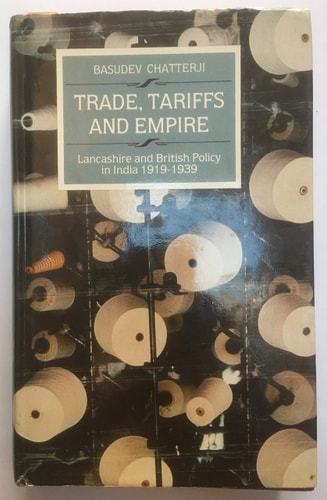
Trade, Tariffs and Empire: Lancashire and British Policy in India 1919-1939
0
0
As an Amazon Associate and affiliate partner, Menrva Books earns from qualifying purchases. Learn more
Author Description
The period between the end of the First World War and the outbreak of the Second was one of major disturbances in the international economy. These resulted in important changes in Britain and India and in their interrelationship. This book focuses on the Lancashire textile industry, the decline of whose India trade during this period was of both absolute and symbolic significance in the history of Indo-British relations. Chatterji looks at the affairs of Lancashire from on the one hand, within the broader context of the decline and eventual collapse of the pre-1914 international economic order; the influence of British industrial and financial interests; and the imperatives arising out of massive unemployment in Britain. On the other hand, policy-making in India is examined in the context of nationalism; the threats posed to the Raj by growing political activity; the economic interest and political attitudes of businessmen; and the priorities of the government of India. Situated within this comprehensive context, the story of Lancashire provides a useful medium of analysis for the larger themes of economic and political change, and their relative importance in the reshaping of Britain's imperial system.
Menrva's Summary
THE THESIS
This book investigates how the decline of the Lancashire textile trade in India between 1919 and 1939 served as a critical indicator of the broader collapse of the British imperial economic system. Basudev Chatterji, a historian specializing in colonial economic relations, utilizes extensive archival research to analyze the intersection of British industrial interests and the rising tide of Indian nationalism. The work argues that the economic pressures faced by Lancashire were not merely market fluctuations but were deeply intertwined with the political instability of the British Raj and the shifting priorities of imperial governance.
THE SCOPE MAP
What You Will Find
- Analysis of the post-WWI international economic order and its impact on colonial trade.
- Examination of the Lancashire textile industry's decline and its symbolic role in Indo-British relations.
- Investigation into the political influence of British industrial and financial lobbies on imperial policy.
- Assessment of the Indian nationalist movement's influence on economic decision-making and business attitudes.
THE AUTHORITY PERSPECTIVE
Historians and scholars of colonial economics frequently cite this work as a definitive study on the intersection of industrial decline and imperial policy. The text is noted for its rigorous academic density and its ability to synthesize complex economic data with the political realities of the interwar period.
Page Count:
535
Publication Date:
1992-10-01
Publisher:
OUP India
ISBN-10:
0195628152
ISBN-13:
9780195628159
History
Economics
India
Textile industry
Great Britain
British History
Imperialism
Community Tags
Similar Books