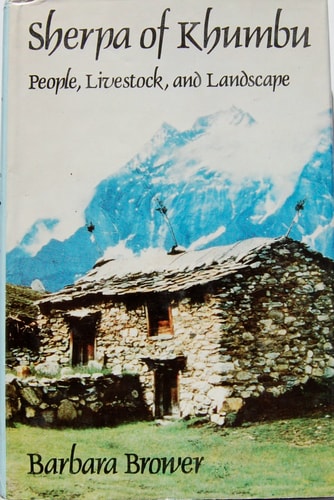
Sherpa of Khumbu: People, Livestock, and Landscape
0
0
As an Amazon Associate and affiliate partner, Menrva Books earns from qualifying purchases. Learn more
Author Description
This study looks at animal management in Sagarmatha National Park in the context of Sherpa subsistance. Brower covers topics such as the intricacy of the man-land relationship, the adaptability of traditional people, and the range of considerations that must be taken into account in any attempt to modify land-use practices. Sherpa history and economy are discussed as are the substantial changes that the traditional life of Khumbu has undergone in the past few decades.
Menrva's Summary
THE THESIS
How do Sherpa communities in the Khumbu region balance traditional livestock management with the ecological pressures of a changing landscape and national park regulations? Barbara Brower, an expert in cultural geography, utilizes extensive field research and ethnographic observation to analyze the complex man-land relationship within Sagarmatha National Park. The book argues that traditional subsistence strategies are highly adaptive, yet they face significant disruption from modern economic shifts and conservation policies. By examining the intersection of history, economy, and ecology, Brower provides a framework for understanding how land-use practices evolve in high-altitude environments.
THE SCOPE MAP
What You Will Find
- Analysis of traditional Sherpa livestock management and pastoral systems
- Examination of the socio-economic impacts of Sagarmatha National Park regulations
- Historical overview of Sherpa subsistence patterns and land-use evolution
- Case studies on the adaptability of indigenous populations to environmental and policy changes
THE AUTHORITY PERSPECTIVE
Experts in Himalayan studies and cultural geography frequently cite this work as a foundational text for understanding the human ecology of the Everest region. Readers often note the academic rigor and the detailed, evidence-based approach Brower takes toward complex environmental management issues.
Page Count:
230
Publication Date:
1992-03-12
Publisher:
Oxford University Press
ISBN-10:
0195626141
ISBN-13:
9780195626148
Anthropology
Sociology
Geography