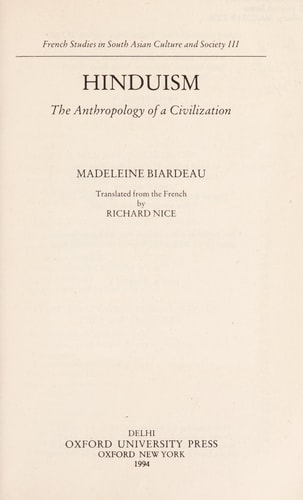
The Anthropology of a Civilization
0
0
As an Amazon Associate and affiliate partner, Menrva Books earns from qualifying purchases. Learn more
Author Description
Hinduism, because of its many dimensions, is often regarded as a mixture of various components. However, the archeological monuments and literary texts discovered over the past few centuries indicate an underlying unity. The most crucial of these "testimonies of Hindu civilization" are of a socio-religious nature and have special meaning for most Hindus. Madeleine Biardeau demonstrates that the Hindu religion is intricately connected to the caste system, but in spite of this, the Hindu religion has evolved and diversified over time augmenting its unmistakable and enduring character. This fascinating analysis uncovers the basic components of the Hindu way of life shedding new light on Hinduism's unity.
Menrva's Summary
THE THESIS
This work investigates the fundamental structural unity of Hindu civilization by examining the intersection of socio-religious practices and the caste system. Madeleine Biardeau, a noted scholar in Indian studies, utilizes a synthesis of archaeological evidence and classical literary texts to argue that Hinduism possesses an inherent coherence despite its apparent diversity. Her framework posits that the caste system serves as a primary mechanism through which the religion has evolved while maintaining its core identity over centuries.
THE SCOPE MAP
What You Will Find
- Analysis of the relationship between the caste system and religious practice
- Examination of archaeological monuments as historical evidence
- Interpretation of classical literary texts as primary sources
- Exploration of the socio-religious components that define the Hindu way of life
THE AUTHORITY PERSPECTIVE
Scholars and students of South Asian culture frequently identify this text as a foundational contribution to the structuralist understanding of Indian society. Readers often note the academic density of the prose, which requires a significant background in the subject matter to fully grasp the author's nuanced arguments.
Page Count:
196
Publication Date:
1994-05-12
Publisher:
Oxford University Press
ISBN-10:
019563389X
ISBN-13:
9780195633894
Religion
Hinduism
Sociology
Anthropology
Community Tags
Similar Books