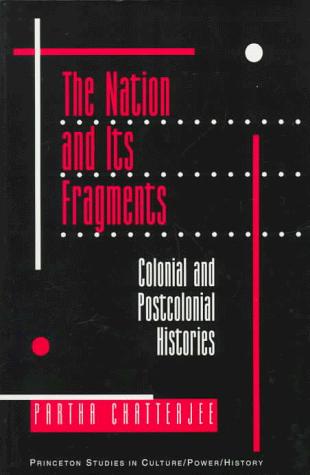
The Nation and Its Fragments
0
0
As an Amazon Associate and affiliate partner, Menrva Books earns from qualifying purchases. Learn more
Author Description
In this book, the prominent theorist Partha Chatterjee looks at the creative and powerful results of the nationalist imagination in Asia and Africa that are posited not on identity but on difference with the nationalism propagated by the West. Arguing that scholars have been mistaken in equating political nationalism with nationalism as such, he shows how anticolonialist nationalists produced their own domain of sovereignty within colonial society well before beginning their political battle with the imperial power. These nationalists divided their culture into material and spiritual domains, and staked an early claim to the spiritual sphere, represented by religion, caste, women and the family, and peasants. Chatterjee shows how middle- class elites first imagined the nation into being in this spiritual dimension and then readied it for political contest, all the while "normalizing" the aspirations of the various marginal groups that typify the spiritual sphere.While Chatterjee's specific examples are drawn from Indian sources, with a copious use of Bengali language materials, the book is a contribution to the general theoretical discussion on nationalism and the modern state. Examining the paradoxes involved with creating first a uniquely non- Western nation in the spiritual sphere and then a universalist nation-state in the material sphere, the author finds that the search for a postcolonial modernity is necessarily linked with past struggles against modernity.
Menrva's Summary
THE THESIS
This book investigates the paradoxes of postcolonial modernity by examining how nationalist movements in Asia and Africa established a sovereign domain of culture distinct from Western political models. Partha Chatterjee, a prominent political theorist, utilizes historical data and Bengali source materials to argue that anticolonial nationalists successfully carved out a spiritual sphere—encompassing religion, family, and social structures—long before engaging in direct political conflict with imperial powers. By bifurcating culture into material and spiritual domains, these elites created a unique national identity that challenged the universalist assumptions of the modern state.
THE SCOPE MAP
What You Will Find
- Analysis of the material versus spiritual domains in nationalist thought
- Historical case studies focused on Indian and Bengali social structures
- Theoretical framework for understanding non-Western nationalism
- Examination of the role of marginal groups in the construction of national identity
THE AUTHORITY PERSPECTIVE
Scholars frequently cite this work as a foundational text for understanding the complexities of postcolonial state-building and the limitations of Western-centric political theory. Readers often note the academic density of the prose, which requires a strong background in political philosophy to fully grasp the author's nuanced arguments.
Page Count:
300
Publication Date:
1998-01-01
Publisher:
South Asia Books
ISBN-10:
019563747X
ISBN-13:
9780195637472
History
Nationalism
Sociology
Asian Studies