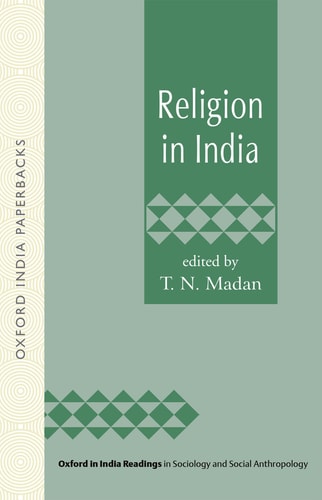
Religion in India: Oxford in India Readings in Sociology and Social Anthropology
0
0
As an Amazon Associate and affiliate partner, Menrva Books earns from qualifying purchases. Learn more
Author Description
All the great religions of the world--Buddhism, Jainism, Hinduism, Christianity, Sikhism, Islam, Judaism, and Zoroastrianism--are found within the geographic boundaries of India, each affecting people in some respect. Focusing on the sociological and anthropological aspects, this study attempts to elucidate the major approaches--evolutionary, structuralist, functionalist, cultural/analytical, phenomenological, and hermeneutic, while offering the reader a clear understanding of the religions' perspectives on time, space, knowledge, sacred persons, and reorientation of the sacred.
Menrva's Summary
THE THESIS
This volume investigates the complex intersection of diverse religious traditions and their sociological impact within the Indian subcontinent. T. N. Madan, a distinguished scholar in the field of social anthropology, compiles a rigorous selection of academic perspectives to examine how major world religions function within the specific cultural and geographic framework of India. The text utilizes a multidisciplinary approach to analyze how these belief systems shape social structures, individual identity, and the collective understanding of the sacred.
THE SCOPE MAP
What You Will Find
- Comprehensive analysis of major world religions including Hinduism, Buddhism, Islam, and Sikhism.
- Theoretical frameworks including structuralist, functionalist, and phenomenological approaches.
- Examination of core concepts such as time, space, and sacred knowledge.
- Scholarly essays detailing the sociological and anthropological dimensions of religious practice.
THE AUTHORITY PERSPECTIVE
Experts frequently cite this collection as a foundational text for students and researchers exploring the sociology of religion in South Asia. Readers often note the academic density of the prose, which provides a high-level synthesis of complex anthropological theories.
Page Count:
460
Publication Date:
1992-04-01
Publisher:
Oxford University Press
ISBN-10:
0195630920
ISBN-13:
9780195630923
Religion
Anthropology
India religion
Sociology
India
Social Science
Community Tags
Similar Books