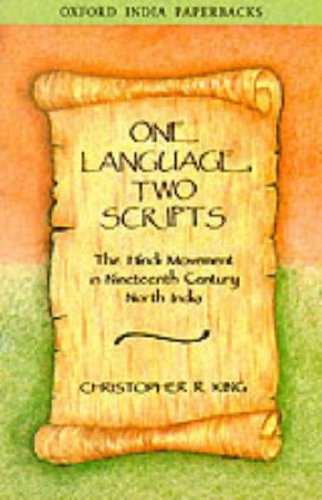
One Language, Two Scripts
0
0
As an Amazon Associate and affiliate partner, Menrva Books earns from qualifying purchases. Learn more
Author Description
The Hindi movement in nineteenth century north India provides an excellent example of the relationships between language, religion and nationalism, and several scholars have dealt with various aspects of these relationships. This study differs form previous ones in examining not only thepolitical, but also the social and cultural aspects of the Hindi movement, particularly on the local and provincial levels. Moreover, it is based on extensive use of both Hindi and English sources, including a thorough research of official rcords such as education reports, publication statisticsand the like. Finally, it stresses the importance of voluntary language associations which both reflected and intensified the Hindi movement.After an introduction which provides the theoretical, historical, linguistic and social background, and a review of previous studies, the author traces certain aspects of the history of Hindi and Urdu literature from the late eighteenth to the early twentieth century and the development andexpansion of the printing of books and periodicals in these languages. This is followed by an outline of the essential features of the government's language policy and its important though contradictary role in shaping the Hindi movement, and an analysis of both indigenous and governmentaleducational systems in terms of languages studied, the social background of the students, and the relationship of education to employment, especially government employment. One chapter is devoted to the history of the Hindi movement, from the initial controversies of the 1860s to the governmentdecision of 1900 favouring Hindi and the Nagari script. The organization of the study is both chronological and topical, each succeeding chapter beginning its narrative and analysis at a later date than the preceeding chapter and dealing with a different aspect of the subject.The principal thesis of this book is that the Hindi movement of the nineteenth century expressed a Hindu nationalism whose
Menrva's Summary
THE THESIS
This book investigates how the Hindi movement in nineteenth-century North India functioned as a primary vehicle for the expression of Hindu nationalism through the intersection of language, religion, and political identity. Christopher R. King utilizes a comprehensive interdisciplinary approach, drawing from extensive archival research in both Hindi and English sources. By analyzing official government records, educational reports, and the influence of voluntary language associations, King argues that the movement was not merely a linguistic shift but a complex social and cultural transformation that redefined the relationship between the state and its citizens.
THE SCOPE MAP
What You Will Find
- A detailed historical analysis of the Hindi-Urdu linguistic divide from the late eighteenth to the early twentieth century.
- An examination of the role of printing, periodicals, and voluntary associations in mobilizing public opinion.
- A critical review of colonial government language policies and their impact on employment and education.
- A chronological and topical study of the Nagari script controversy and the 1900 government decision.
THE AUTHORITY PERSPECTIVE
Scholars in South Asian studies frequently cite this work as a foundational text for understanding the sociopolitical dynamics of language movements in colonial India. Readers often note the academic density of the prose and the meticulous use of primary source data to support the author's historical arguments.
Page Count:
246
Publication Date:
1999-01-01
Publisher:
OUP India
ISBN-10:
019565112X
ISBN-13:
9780195651126
History
Politics
India
Nationalism
Linguistics
Sociology
Community Tags
Similar Books