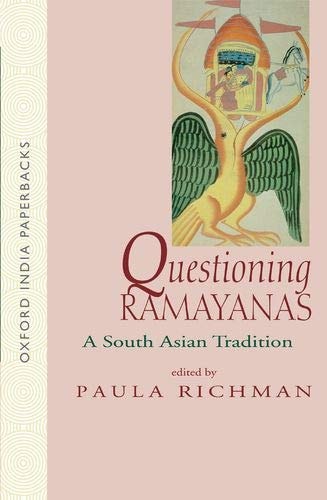
Questioning Ramayanas: A South Asian Tradition
0
0
As an Amazon Associate and affiliate partner, Menrva Books earns from qualifying purchases. Learn more
Author Description
Language: EnglishPages: 451ForewordI have been told that the poet Intizar Hussain, speaking at agathering of authors at Kathmandu, stated that he had neverknown that Ayodhya actually exists on a map of the world. Ithad always been for him a fabulous kingdom, a sound, a resonance.Mter the demolition of the Babri Masjid, he was compelled to remaphis geography as a writer.In a sense, remapping the location of the katha, or the story, ofRama has been a constant feature of Indian civilization. This wasmade quite apparent in the earlier companion volume edited by PaulaRichman, Many Ramayanas, which added to our awareness of therange of variants and versions, an awareness which has led to muchdiscussion on these in recent times. The Valmiki Ramayana shouldnot necessarily be taken as a fixed text and the others necessarily asvariants of this fixed text, for the latter often contextualized thediffering worldviews of particular segments of Indian society. Eachvariant is better seen in its own specific context before it is juxtaposedwith the authoritative versions.The range of variants-now generally recognized and part of thediscussion on the story of Rama-includes those previously ignoredor neglected, as for example from the regional languages, or even thedialects of these; tribal versions; and some composed by and for thelower castes. The collecting of these, which has revealed a newdiscourse on the Katha of Rama, is of course not a sufficient point atwhich to stop, for they too must be analysed. Questioning theRamayana is therefore questioning that which is seen as the norm,but it also involves an explanation of w
Menrva's Summary
THE THESIS
This volume investigates the diverse, often contradictory ways the Ramayana tradition has been interpreted, adapted, and challenged across South Asian history. Paula Richman, a scholar of South Asian religions, compiles a collection of essays that examine how various regional, caste-based, and tribal versions of the Rama story function as social and political commentary. By moving beyond the singular authority of the Valmiki Ramayana, the text argues that the story of Rama serves as a flexible framework for articulating competing worldviews and cultural identities.
THE SCOPE MAP
What You Will Find
- Analysis of regional and dialect-specific variants of the Ramayana.
- Examination of tribal and lower-caste perspectives on the Rama narrative.
- Historical context regarding the evolution of the story following modern political events.
- Methodological approaches to comparing authoritative texts with marginalized or neglected versions.
THE AUTHORITY PERSPECTIVE
Scholars frequently cite this work as a foundational text for understanding the pluralistic nature of Indian epic traditions. Experts highlight the book's academic rigor in deconstructing the monolithic perception of the Ramayana in contemporary discourse.
Page Count:
432
Publication Date:
2003-01-01
Publisher:
Oxford University Press
ISBN-10:
0195664639
ISBN-13:
9780195664638
Politics
History
Religion
Asia
Literary Criticism
India
Mythology
Community Tags
Other Editions(2)

Similar Books