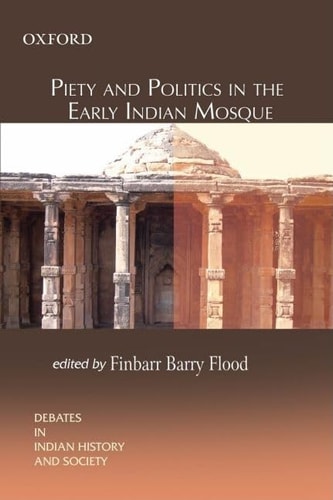
Piety and Politics in the Early Indian Mosque
0
0
As an Amazon Associate and affiliate partner, Menrva Books earns from qualifying purchases. Learn more
Author Description
This volume focuses on a series of mosques constructed after north-west India came under the political control of the Ghurid sultanate of Afghanistan in the 1190s. The most famous of the group is the Qutb Mosque in Delhi. The book explores the complex relationship between pre-modern architecture, history, and modern historiography. It brings together divergent voices that have enriched nineteenth- and twentieth-century scholarship on some of the earliest surviving mosques in South Asia.Piety and Politics analyzes the different traditions that contributed to the development of the earliest mosques in South Asia. It examines the evidence that architecture offers for cultural exchange, identity formation, and political polemics in the Ghurid and early Delhi sultanates in order to understand the context of contemporary debates, memories, and perceptions related to the mosques that form the subject of the volume. Presenting a range of perspectives on the meaning of pre-modern monuments, it contributes to broader debates on the nature of modern historical writing.The collection includes writings on the beginnings of mosque architecture in South Asia (Alka Patel); the socio-political milieu of these structures (André Wink and Richard M. Eaton); controversies concerning the origins of the Qutb Mosque and Qutb Minar (Alexander Cunningham and J.D. Beglar); continuities and innovations in early Rajasthani mosques (Michael W. Meister and Robert Hillenbrand); and recent approaches to interpreting the Qutb complex in Delhi by Mohammad Mujeeb, Fritz Lehmann, Sunil Kumar, Anthony Welch, Hussein Keshani, and Alexandra Bain.Highlighting both continuities and ruptures in the architectural traditions of the period, Finbarr Barry Flood's introduction constructs a socio-political context for the various academic positions represented in the volume. Flood underlines the need for multiple narratives and variant readings of the monuments.Part of the prestigious Debates in Indian History and
Menrva's Summary
THE THESIS
This volume investigates how the architectural development of early mosques in South Asia reflects the complex intersection of religious piety, political authority, and modern historiographical debates. Finbarr Barry Flood, a scholar of Islamic art and architecture, curates a collection of essays that examine the Ghurid sultanate's influence on the built environment of north-west India. By synthesizing diverse academic perspectives, the book argues that these monuments serve as critical sites for understanding cultural exchange, identity formation, and the evolution of historical memory in the region.
THE SCOPE MAP
What You Will Find
- Historical analysis of mosque construction following the Ghurid sultanate's expansion in the 1190s.
- Examination of the Qutb Mosque and Qutb Minar as case studies for architectural and political controversy.
- A compilation of scholarly perspectives ranging from nineteenth-century colonial archaeology to contemporary academic interpretations.
- Methodological discussions on how pre-modern monuments are utilized in modern political and historical discourse.
THE AUTHORITY PERSPECTIVE
Experts recognize this volume as a vital resource for understanding the historiography of South Asian Islamic architecture. Readers frequently note the academic density of the prose, which effectively bridges the gap between architectural history and broader socio-political debates.
Page Count:
350
Publication Date:
2008-11-30
Publisher:
Oxford University Press
ISBN-10:
0195695127
ISBN-13:
9780195695120
Politics
History
Architecture
Religion
Mosques
India religion
Community Tags
Similar Books