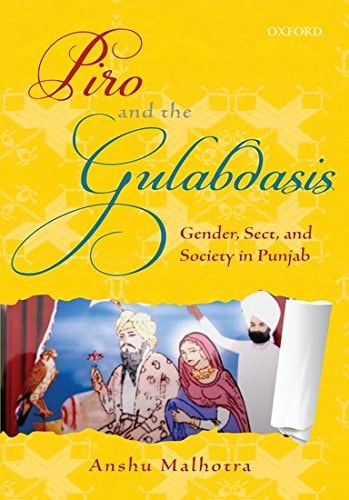
Piro and the Gulabdasis: Gender, Sect, and Society in Punjab
0
0
As an Amazon Associate and affiliate partner, Menrva Books earns from qualifying purchases. Learn more
Author Description
The middle decades of the nineteenth century in Punjab were a time of the disintegrating Sikh empire and an emerging colonial one. Situating her study in this turbulent time, Anshu Malhotra delves into the tumultuous life of a hitherto unknown woman, Piro, and her little-known sect, the Gulabdasis. Piro's forceful autobiographical narrative knits a fanciful tale of abduction and redemption, while also claiming agency over her life. Piro's is the extraordinary voice of a low-caste Muslim and a former prostitute, who reinvents her life as an acolyte in a heterodox sect.Malhotra argues for the relevance of such a voice for our cultural anchoring and empowering politics. Piro's remarkable poetry deploys bhakti imaginary in exceptional ways, demonstrating how it enriched the lives of women and low castes. Malhotra's work is also a pioneering study of the afterlife of Piro and the Gulabdasis, highlighting the cultural scripts that inform the stories that we tell and the templates that renew the tales we fabricate.
Menrva's Summary
THE THESIS
This book investigates the intersection of gender, caste, and religious identity in nineteenth-century Punjab through the life of Piro, a marginalized woman who found agency within the heterodox Gulabdasi sect. Anshu Malhotra, a scholar of South Asian history, utilizes Piro's autobiographical poetry and historical records to reconstruct the social landscape of a region transitioning from the Sikh empire to British colonial rule. The author argues that Piro's narrative provides a critical lens for understanding how subaltern voices utilized bhakti traditions to challenge prevailing social hierarchies and construct new identities. By examining both the historical figure and the subsequent cultural memory of the Gulabdasis, Malhotra demonstrates how marginalized groups navigated and resisted the constraints of their time.
THE SCOPE MAP
What You Will Find
- Historical analysis of the nineteenth-century Punjab region during the transition between the Sikh empire and British colonial administration.
- Examination of the Gulabdasi sect as a site of heterodox religious practice and social refuge.
- Analysis of autobiographical poetry as a primary source for understanding subaltern agency and gendered experience.
- Exploration of the cultural scripts and templates that shape the historical memory of marginalized figures.
THE AUTHORITY PERSPECTIVE
Scholars in the field of South Asian history and gender studies recognize this work as a significant contribution to the recovery of subaltern voices in colonial archives. Experts frequently highlight the text for its nuanced methodology in balancing literary analysis with rigorous historical contextualization.
Page Count:
408
Publication Date:
2017-05-30
Publisher:
Oxford University Press
ISBN-10:
0199468184
ISBN-13:
9780199468188
Biography
History
Religion
India
Gender Studies
Punjab India
Sociology
India religion
Community Tags
Similar Books