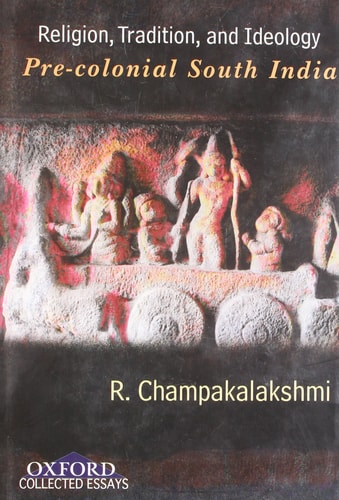
Religion, Tradition, and Ideology: Pre-colonial South India
0
0
As an Amazon Associate and affiliate partner, Menrva Books earns from qualifying purchases. Learn more
Author Description
This book discusses the multiple facets, dominant characteristics, and historical trajectories of religious traditions in pre-colonial south India. It explores how Hinduism, primarily the Brahmanical tradition, developed and reworked itself in the context of challenges posed by Buddhism and Jainism to become the dominant tradition and ideology in south Indian society and polity. Examining the linkages between religion and politics, the volume also investigates alternative vernacular traditions, rituals and practices, temple architecture, iconography and other representational art forms that evolved as symbols of power. A detailed introduction weaves together the different aspects and introduces new questions for further research.This will interest scholars and students of ancient and early medieval Indian history particularly those concerned with South Indian history, religion, and culture.
Menrva's Summary
THE THESIS
This volume investigates the complex interplay between religious evolution, political power, and social ideology in pre-colonial South India. R. Champakalakshmi, a noted historian of early medieval India, utilizes a collection of scholarly essays to analyze how Brahmanical traditions adapted to the competitive presence of Buddhism and Jainism. The work argues that religious institutions functioned as essential instruments of statecraft and social organization, shaping the regional identity of the Indian peninsula over several centuries.
THE SCOPE MAP
What You Will Find
- Analysis of the historical development of Brahmanical Hinduism in relation to competing religious traditions.
- Examination of temple architecture and iconography as physical manifestations of political authority.
- Investigation into vernacular religious practices and their role in local social structures.
- Synthesis of religious history and political history within the context of early medieval South Indian society.
THE AUTHORITY PERSPECTIVE
Scholars and students of Indian history recognize this collection as a rigorous contribution to the study of regional religious evolution. The text is noted for its academic density and its ability to synthesize complex archaeological and textual evidence into a coherent historical framework.
Page Count:
600
Publication Date:
2011-06-13
Publisher:
Oxford University Press
ISBN-10:
0198070594
ISBN-13:
9780198070597
Religion
History
India religion
South Asia
Brahmanism
India
Ancient History
Community Tags
Similar Books














