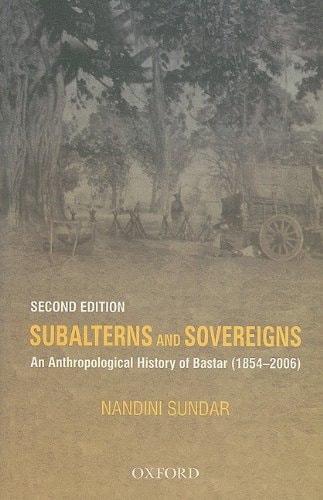
Subalterns and Sovereigns: An Anthropological History of Bastar (1854-2006)
0
0
As an Amazon Associate and affiliate partner, Menrva Books earns from qualifying purchases. Learn more
Author Description
Subalterns and Sovereigns traces the expansion of the colonial and the post-colonial state in Bastar, central India between 1854-2006, In particular, it looks at the manner in which the state was constituted, focusing on certain critical moments when the structures set into place by the colonial state were contested. The central themes include the growing restrictions on popular access to land and forest, and the changing popular notions of kingship and polity, which act as the matrix through which structures of resistance are defined.The author's account of the region is at once the outcome of an intellectual as well as personal encounter with the "field'" It is divided into three parts: Section One, "Recreated Pasts", portrays the pre-colonial economy and polity. It dispels notions of dominant history that see Bastar and other such places as untouched and isolated prior to colonialism, showing instead, the degree of social and political fluidity in the region in the pre-colonial period.Section 2, "Rebellious Pasts", contains accounts of both "major" and "minor" resistance to the colonizing process. It throws light on the play of multiple histories, differently constructed and differently understood by the actors involved.The final section, "Uncertain Futures", highlights the contradictions faced by tribal society today and the processes of cultural redefinition engendered by these contradictions. The second edition includes an Afterword which discusses contemporary issues concerning the formation of the state of Chattisgarh.
Menrva's Summary
THE THESIS
How did the expansion of colonial and post-colonial state structures in Bastar, India, fundamentally alter local governance, land access, and tribal resistance between 1854 and 2006? Nandini Sundar, a scholar of sociology and anthropology, utilizes extensive field research and historical archival analysis to examine the intersection of state formation and indigenous agency. The book argues that Bastar was never an isolated entity, but rather a region defined by social fluidity and complex political structures that were systematically constrained by external administrative impositions.
THE SCOPE MAP
What You Will Find
- A longitudinal analysis of Bastar's political and economic evolution from 1854 to 2006.
- An examination of the transition from pre-colonial social fluidity to colonial and post-colonial state rigidity.
- Case studies of both major and minor acts of resistance against land and forest restrictions.
- An investigation into the cultural redefinition of tribal identity in the face of modern political contradictions.
THE AUTHORITY PERSPECTIVE
Scholars in the field of South Asian studies recognize this work as a foundational text for understanding the intersection of anthropology and history in tribal regions. Readers frequently note the academic density of the prose, which provides a rigorous, evidence-based critique of state-building processes in central India.
Page Count:
380
Publication Date:
2008-09-15
Publisher:
Oxford University Press
ISBN-10:
0195697049
ISBN-13:
9780195697049
History
Sociology
Anthropology
India
Ethnic relations