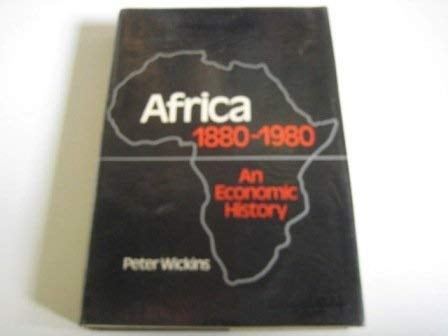
Africa 1880-1980: An Economic History
0
0
As an Amazon Associate and affiliate partner, Menrva Books earns from qualifying purchases. Learn more
Author Description
The economic history of 20th-century Africa has often been attributed to either the legacy of imperialism and exploitation by powerful and unscrupulous foreign business, or to hasty decolonization and ill-conceived socialism. This timely work looks well beyond these explanations to provide a balanced, in-depth investigation of Africa's economic fortunes following the partition of Africa one century ago. Neither an indictment of nor an apology for colonialism, and neither a glorification nor a critique of the post-colonial achievement, Wickins' study takes into account the pressure of changing circumstances and the evolution of opinion in and outside of Africa to help clarify the course of Africa's recent economic history.
Menrva's Summary
THE THESIS
This work investigates the complex economic trajectory of Africa between 1880 and 1980, challenging simplistic narratives that attribute the continent's economic status solely to colonial exploitation or post-colonial policy failures. Peter L. Wickins, an established scholar in economic history, utilizes a broad range of historical data to examine the structural shifts and external pressures that shaped African economies. The text moves away from ideological bias, instead focusing on the interplay between global market forces, internal development, and the evolving political landscape of the century.
THE SCOPE MAP
What You Will Find
- A comprehensive analysis of economic development from the partition of Africa through the end of the 20th century.
- An examination of the impact of colonial-era business practices on long-term economic structures.
- A critical review of post-colonial economic strategies, including socialist experiments and decolonization efforts.
- A balanced assessment of how changing global opinions and local circumstances influenced economic policy.
THE AUTHORITY PERSPECTIVE
Experts recognize this volume as a significant contribution to the study of African economic development, noting its commitment to a neutral, evidence-based approach. The prose is dense and academic, making it a valuable resource for students and researchers seeking a nuanced understanding of the continent's economic history.
Page Count:
304
Publication Date:
1987-01-01
Publisher:
Oxford University Press
ISBN-10:
0195704169
ISBN-13:
9780195704167
Economics
History
Africa
African history
Economic History
Community Tags
Similar Books