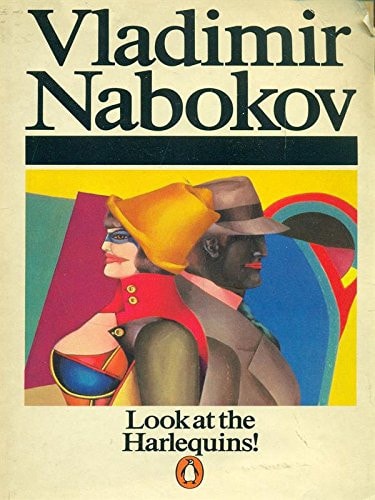
Look at the Harlequins!
0
0
As an Amazon Associate and affiliate partner, Menrva Books earns from qualifying purchases. Learn more
Author Description
As intricate as a house of mirrors, Nabokov’s last novel is an ironic play on the Janus-like relationship between fiction and reality. It is the autobiography of the eminent Russian-American author Vadim Vadimovich N. (b. 1899), whose life bears an uncanny resemblance to that of Vladimir Vladimirovich Nabokov, though the two are not to be confused (?). Focusing on the central figures of his life — his four wives, his books, and his muse, Dementia — the book leads us to suspect that the fictions Vadim has created as an author have crossed the line between his life’s work and his life itself, as the worlds of reality and literary invention grow increasingly indistinguishable. One of the twentieth century’s master prose stylists, Vladimir Nabokov was born in St. Petersburg in 1899. He studied French and Russian literature at Trinity College, Cambridge, then lived in Berlin and Paris, where he launched a brilliant literary career. In 1940 he moved to the United States, and achieved renown as a novelist, poet, critic, and translator. He taught literature at Wellesley, Stanford, Cornell, and Harvard. In 1961 he moved to Montreux, Switzerland, where he died in 1977. “One of the greatest masters of prose since Conrad.” — Harper’s
Menrva's Summary
THE PULSE
The narrative centers on the life of Vadim Vadimovich N., an author whose existence mirrors that of his creator, forcing a confrontation between the boundaries of lived experience and literary invention. Vadim recounts his life through the lens of his four marriages, his bibliography, and his elusive muse, Dementia. The protagonist struggles to reconcile his personal history with the fictional worlds he has constructed, creating a recursive loop of identity. The narrative framework is presented as a pseudo-autobiography, utilizing a non-linear structure that challenges the reader to distinguish between the author's reality and the protagonist's fabrications.
INSIDE THE PAGES
- Metafictional commentary on the nature of authorship
- Unreliable first-person narration
- Recursive references to the author's own bibliography
- Complex, layered prose style
- Exploration of the Janus-like relationship between life and art
- Focus on the influence of four distinct marital relationships
- Examination of the concept of a literary muse
- Playful subversion of autobiographical conventions
THE COLLECTIVE ECHO
Discussion often centers on the intricate, mirror-like structure of the prose and the deliberate blurring of lines between Nabokov and his protagonist. Readers frequently highlight the technical precision of the writing, noting how the author uses the text to interrogate the act of creation itself. Critics observe that the pacing is dictated by the protagonist's shifting memories rather than a traditional linear plot. The work is often analyzed for its thematic preoccupation with the persistence of memory and the fallibility of the self-narrative. Many readers find the experience of reading the book to be a demanding intellectual exercise that rewards careful attention to linguistic patterns and allusions.
Page Count:
200
Publication Date:
1980-08-28
Publisher:
Penguin Books Ltd
ISBN-10:
0140046577
ISBN-13:
9780140046571
Literary Fiction
Classics
Metafiction
Autobiographical fiction
Literary
Russian
Modernist
Community Tags
Similar Books