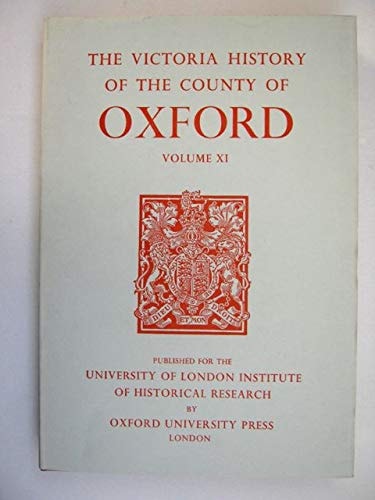
A History of the County of Oxford: Volume XI: Wootton Hundred (Northern Part)
0
0
As an Amazon Associate and affiliate partner, Menrva Books earns from qualifying purchases. Learn more
Author Description
This volume contains the histories of 19 parishes in the northern part of Wootton hundred, stretching from Stonesfield, Wootton, and Tackley in the south to Deddington, Barford St. Michael, and South Newington in the north; the other parishes are Glympton, Heythrop, Rousham, Sandford St. Martin, the Astons, the Bartons, the Wortons, and the three Tews. The area, bounded on the east by the river Cherwell and on part of the west by the river Glyme, containsthe small, well documented, market town of Deddington, two outstanding country houses at Heythrop and Rousham, and many other notable secular and ecclesiastical buildings. Probably the best known village is Great Tew, whose development is here reinterpreted in the light of new evidence. The many deserted village sites in the area are treated in detail, and special attention has been given to the arrangement of open fields, of which a local feature was thedevelopment within a single vill of two separate sets of fields, known as ends or sides, as at Deddington, Duns Tew, and South Newington. The complex arrangements for the periodical division of common meadows are well documented in some parishes, particularly North Aston. A feature of religious life in the area was the establishment at Nether and Over Worton in the early 19th century of a strong, locally influential, tradition of evangelical Anglicanism. The volume is illustrated with 20 pages of plates, two church plans, and numerous parish and village maps.
Menrva's Summary
THE THESIS
This volume investigates the historical development, land use, and architectural evolution of 19 parishes within the northern part of the Wootton hundred in Oxfordshire. Alan Crossley, a seasoned editor for the Victoria County History project, synthesizes archival records, archaeological surveys, and primary source documentation to construct a comprehensive administrative and social history of the region. The work provides a rigorous framework for understanding how rural settlements, market towns, and ecclesiastical structures shaped the landscape from the medieval period through the 19th century.
THE SCOPE MAP
What You Will Find
- Detailed historical accounts of 19 specific parishes including Deddington, Great Tew, and Rousham.
- Analysis of agricultural land management, specifically the development of open fields and common meadow divisions.
- Documentation of architectural heritage, covering both secular country houses and ecclesiastical buildings.
- Examination of religious trends, such as the rise of evangelical Anglicanism in the early 19th century.
THE AUTHORITY PERSPECTIVE
Experts and local historians recognize this volume as a foundational reference for the study of Oxfordshire topography and social history. Readers frequently note the academic density of the prose and the meticulous attention to detail regarding land tenure and village development.
Page Count:
368
Publication Date:
1983-01-01
Publisher:
Victoria County History
ISBN-10:
0197227589
ISBN-13:
9780197227589
History
Local History
Reference
British History
Geography
Community Tags
Similar Books