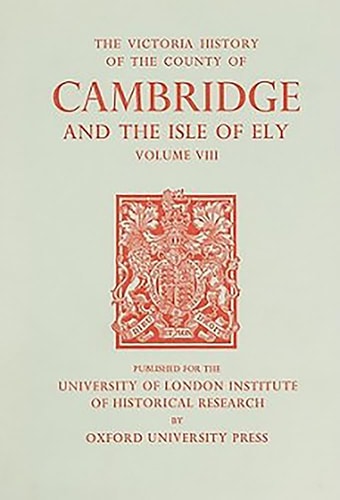
A History of the County of Cambridge and the Isle of Ely: Volume VIII: Armingford and Thriplow Hundreds
0
0
As an Amazon Associate and affiliate partner, Menrva Books earns from qualifying purchases. Learn more
Author Description
This volume covers the two hundreds of Armingford and Thriplow in south-west Cam-bridgeshire. They comprise 23 ancient parishes, lying between the Gogmagog Hills south-east of Cambridge, where an Iron Age hill fort partly survives, and the clay-covered West Cambridge-shire upland. To the north-west they are largely bounded by the Cam or Rhee, to the south by heathlend along the Icknield Way. The land has long been used mainly for arable farming. Some of the villages, which are mostly nucleated, may stand near the sites of Roman or earlier settlement. Those in the far west had some dependent hamlets, mostly vanished long ago. In that area several villages, after the early inclosureof their poor, heavy soils for pasturage, shrank greatly or, as at Clopton and Shingay, became. entirely deserted. Elsewhere open fields survived until the early 19th century. Later in that century coprolites were widely dug; in the 20th com-mercial fruit growing was introduced; the chalk has been dug to make cement and whiting; and some of the larger villages, such as Melbourn, have attracted light industry. During the Second World War much level ground was taken over for airfields. The churches of the area range from the humble early Norman work at Hauxton, through cruciform 13th-century buildings, as at Fowlrnere, to the stately Decorated of Trumpington and Bassingbourn. The Igth century saw much rebuilding and refurnishing, sometimes financed by local religious plays. Several villages retain much timber framed vernacular building. The only aristocratic mansion, Gogmagog House of the dukes of Leeds at Wandlebury, has been demolished, but lesser houses include some well preserved late medieval manor houses and much good, plain Georgian work, as at Trumpington Hall, seat of the Pembertons. The villages near Cambridge have been greatly affected in the 20th century by the spread of population.
Menrva's Summary
THE THESIS
This volume investigates the historical development, land use, and architectural evolution of the Armingford and Thriplow hundreds in south-west Cambridgeshire. A. P. M. Wright utilizes the rigorous, multi-disciplinary methodology characteristic of the Victoria County History project to document the transformation of these 23 ancient parishes. The text synthesizes archaeological evidence, land enclosure records, and architectural surveys to present a comprehensive account of regional change from Roman settlement patterns to 20th-century industrial shifts.
THE SCOPE MAP
What You Will Find
- Detailed historical analysis of 23 ancient parishes within the Armingford and Thriplow hundreds.
- Documentation of land use transitions, including arable farming, early enclosure, and 20th-century commercial fruit growing.
- Architectural surveys of ecclesiastical structures ranging from Norman origins to 19th-century renovations.
- Records of demographic shifts, including the decline of deserted medieval villages and the impact of modern suburban expansion.
THE AUTHORITY PERSPECTIVE
Experts and local historians regard this volume as a foundational reference for the study of Cambridgeshire topography and social history. Readers frequently note the academic density of the prose and the exhaustive level of detail provided for each parish entry.
Page Count:
336
Publication Date:
1982-01-01
Publisher:
Victoria County History
ISBN-10:
0197227570
ISBN-13:
9780197227572
History
Local History
England History
British History
Reference
Geography
Community Tags
Similar Books