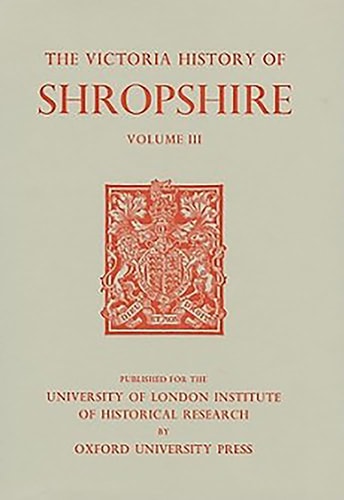
A History of Shropshire: Volume 3
0
0
As an Amazon Associate and affiliate partner, Menrva Books earns from qualifying purchases. Learn more
Author Description
The themes of Volume III are the government and parliamentary representation of Shropshire from their beginnings up to 1974. The long perspective allows the vicissi-tudes of successive institutions of county government to be examined thoroughly. For example, the rise of the justices of the peace is fully chronicled from their in-conspicuous origins under Edward I to the amplitude of their powers and duties in the 17th, 18th, and 19th centuries. Shropshire's medieval government had a number of peculiarities, caused by the county's fron-tier position opposite the hostile Welsh. Accordingly its 'palatine' earldom, its serjeants of the peace, its loss of territory to marcher lordships, and its subjection to the Council in the Marches of Wales receive special attention. From Elizabeth I's reign, as the magistrates' concerns increased, the story comes to include much of the social history of the times. From 1889, when the county council was formed, that history has been one of unprecedented penetration by local government into formerly untouched areas of local and personal affairs. The institutions of Shropshire's govern-ment provided opportunities for influence and advancement; the volume thus em-bodies a history of the fortunes of Shrop-shire's leading men and families. Most prominent in the Middle Ages were the earls of Shrewsbury, Arundel, and March. Since then the families of Corbet, Newport, Herbert, Clive, and Bridgeman have been among the weightiest. Linked with their fortunes were those of smaller landowners and local officials. In the 18th century, with the appointments of itsfirst permanent county treasurer and of its first county surveyor, Thomas Telford, Shropshire took a large step towards the formation of a modern county bureaucracy. Nowhere has the play of ambition and manouvre been more openlyexercised than in elections to Parliament. The volume explores the intricacies of Shrop-shire electioneering from Edward I's reign to the general election of October
Menrva's Summary
THE THESIS
This volume investigates the evolution of government and parliamentary representation in Shropshire from the medieval period through 1974. Author G. C. Baugh utilizes the extensive archival resources of the Victoria County History project to trace the development of local administrative institutions. The work argues that the county's unique frontier status and its shifting political landscape reflect broader patterns in English governance and social hierarchy. By examining the rise of the magistracy and the professionalization of county bureaucracy, the text provides a comprehensive record of regional authority.
THE SCOPE MAP
What You Will Find
- Detailed analysis of Shropshire's administrative history from the reign of Edward I to the 20th century.
- Examination of the impact of the Welsh Marches on local governance and the 'palatine' earldom.
- Documentation of the rise of justices of the peace and the eventual formation of the county council in 1889.
- Biographical insights into influential families such as the Corbets, Newports, and Clives, alongside the administrative contributions of figures like Thomas Telford.
- A thorough study of parliamentary electioneering practices and the shifting influence of local landowners.
THE AUTHORITY PERSPECTIVE
Experts recognize this volume as a foundational reference for regional historiography, valued for its meticulous archival research and dense factual reporting. Scholars frequently cite the work for its detailed account of the transition from medieval administrative structures to modern bureaucratic systems.
Page Count:
406
Publication Date:
1979-01-01
Publisher:
Victoria County History
ISBN-10:
0197227309
ISBN-13:
9780197227305
History
Local History
British History
Government
Political History
Reference
Community Tags
Similar Books