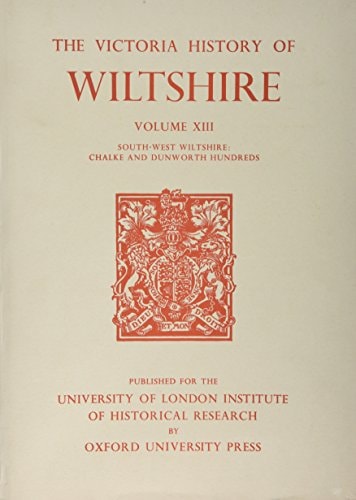
A History of Wiltshire: Volume XIII: South-West Wiltshire: Chalke and Dunworth Hundreds
0
0
As an Amazon Associate and affiliate partner, Menrva Books earns from qualifying purchases. Learn more
Author Description
Chalke and Dunworth hundreds are in south-west Wiltshire on the Dorset border. The parishes of Chalke hundred were united by being part of Wilton abbey's estate before the Norman Conquest, but most of the hundred is homogeneous. Long and narrow parishes lie north and south across the river Ebble and are characterized by extensive chalk downs. Until farmsteads were built on the downs in the 19th cen-tury, nearly all settlement was in small riverside villages. From the Reformation to the 19th century the earls of Pembroke owned most of the eastern parishes. Sheep--and-corn husbandry and more recently arable and dairy farming was the pattern of agriculture in all the parishes except Semley where there is a remarkable survival of common pastures. Dunworth hundred is largely in the Vale of Wardour, and land in most of its parishes belonged to the Barons Arundell of War-dour as successors to Shaftesbury abbey. It is an area of broken landscape and mixed farming in which only Tisbury has grown larger than an ordinary village. Except at Tisbury, there has been little manufactur-ing in the area, but Portland stone has been extensively quarried at Chilmark, Teffont Evias, and Tisbury, and greensand stone has been quarried at the Donheads. Partly because of its stone, Dunworth hundred is notable for its secular buildings. The castle at Wardour is the only one to survive in Wiltshire; Fonthill Abbey in Fonthill Gifford was the most remarkable house of its day in England. Among the many farm-houses of local stone which survive from the Middle Ages is Place Farm at Tisbury, which was frequently visited by the abbess of Shaftesbury and has the largest medieval barn in England. Except for Sedgehill parish and part of Donhead St. Mary parish both hundreds are in an Area of Outstanding Natural Beauty: the exceptions are in aSpecial Landscape Area.
Menrva's Summary
THE THESIS
This volume investigates the historical development, land ownership, and agricultural evolution of the Chalke and Dunworth hundreds in south-west Wiltshire. D. A. Crowley, an established editor within the Victoria County History project, synthesizes archival records and topographical data to document the administrative and social history of this specific region. The text provides a comprehensive framework for understanding how ecclesiastical estates, noble landholdings, and local geography shaped the settlement patterns and economic activities of these parishes from the medieval period through the 19th century.
THE SCOPE MAP
What You Will Find
- Detailed administrative history of the Chalke and Dunworth hundreds within the Dorset border region.
- Analysis of agricultural shifts, including sheep-and-corn husbandry and the transition to dairy farming.
- Documentation of architectural history, focusing on the influence of local stone quarrying on secular and ecclesiastical buildings.
- Examination of land ownership transitions from monastic estates to secular nobility, such as the earls of Pembroke and the Barons Arundell.
THE AUTHORITY PERSPECTIVE
Experts recognize this volume as a foundational reference for local historians and researchers focusing on Wiltshire topography and land use. Readers frequently note the academic density of the prose, which serves as a standard scholarly resource for regional historical studies.
Page Count:
323
Publication Date:
1987-01-01
Publisher:
Victoria County History
ISBN-10:
0197227694
ISBN-13:
9780197227695
History
British History
Great Britain
Geography
Reference
Local History
Community Tags
Similar Books