Two Theories of Morality
0
0
As an Amazon Associate and affiliate partner, Menrva Books earns from qualifying purchases. Learn more
Author Description
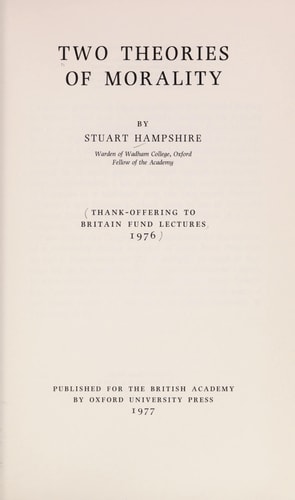
In this expanded version of his "Thank-Offering to Britain Fund Lectures", delivered at the British Academy in February 1976, Stuart Hampshire compares two radically different conceptions of morality, those of Aristotle and Spinoza, authors, he claims, of the most plausible of all moral philosophies. He discusses the relation between moral intuitions and moral theory, and the contrasting ideas of moral normality and moral conversion. Spinoza's theory of the relation between mind and body is expounded and its relevance to recent theories is explained.
Menrva's Summary
THE THESIS
This work investigates the fundamental tension between the Aristotelian and Spinozist conceptions of morality to determine which framework offers a more plausible account of human conduct. Stuart Hampshire, a prominent British philosopher, utilizes his 1976 British Academy lectures as a foundation to examine the intersection of moral intuition and systematic theory. He contrasts the idea of moral normality, often associated with Aristotle, against the concept of moral conversion found in Spinoza’s work. By analyzing the mind-body relationship within these frameworks, Hampshire evaluates their ongoing relevance to contemporary philosophical discourse.
THE SCOPE MAP
What You Will Find
- A comparative analysis of Aristotelian virtue ethics and Spinozist rationalism.
- An examination of the relationship between individual moral intuition and formal moral theory.
- A discussion on the distinction between moral normality and the process of moral conversion.
- An exposition of Spinoza’s theory regarding the mind-body connection and its application to modern psychological and philosophical theories.
THE AUTHORITY PERSPECTIVE
Experts recognize this text as a significant contribution to the study of comparative ethics, noting its clarity in bridging classical thought with modern concerns. Readers frequently highlight the academic density of the prose, which requires a foundational understanding of both Aristotle and Spinoza to fully grasp the author's arguments.
Page Count:
104
Publication Date:
1976-01-01
Publisher:
Oxford University Press
ISBN-10:
0197259758
ISBN-13:
9780197259757
Philosophy
Moral Philosophy
Ethics
Community Tags
Similar Books