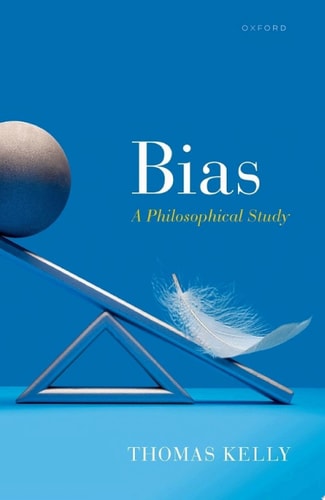
Bias: A Philosophical Study
0
0
As an Amazon Associate and affiliate partner, Menrva Books earns from qualifying purchases. Learn more
Author Description
Bias seems to be everywhere. Biased media outlets decisively influence the political opinions and votes of millions of people. Discriminatory policies favor some racial groups over others. We tend to judge ourselves more favorably than our peers, and more favorably than the evidence warrants. But what is it, exactly, for a person or thing to be biased?In Bias: A Philosophical Study, Thomas Kelly explores a number of foundational questions about the nature of bias and our practices of attributing it. He develops a general framework for thinking about bias, the norm theoretic account, and shows how that framework illuminates much that we say and think about bias in both everyday life and the sciences. He argues provocatively that both morality and rationality sometimes require us to be biased; that groups of people can be biased even if none of their members are; that we are often rationally required to believe that those who disagree with us are biased, even if we know absolutely nothing about why they believe as they do or about their psychologies; and that whether someone counts as biased is often a relative matter. He defends the possibility of what he calls 'biased knowing' and argues that the phenomenon has significant implications for both philosophical methodology and scepticism.A central aim of the book is to expand the range of issues that have thus far been considered under the heading 'the philosophy of bias' by putting new theoretical questions on the table and proposing bold answers that can serve as starting points for future inquiry.
Menrva's Summary
THE THESIS
This book investigates the fundamental nature of bias and the logical criteria used to attribute it to individuals, groups, and institutions. Thomas M. Kelly, a professor of philosophy, utilizes a norm-theoretic framework to analyze how bias functions within everyday discourse and scientific inquiry. He challenges conventional understandings by arguing that bias is not always a failure of rationality or morality, but can sometimes be a requirement of both.
THE SCOPE MAP
What You Will Find
- The norm-theoretic account of bias as a conceptual framework
- Analysis of group-level bias independent of individual member psychology
- Examination of the relationship between disagreement and the attribution of bias
- Exploration of the concept of biased knowing
Scope Limits
- The text does not provide a psychological or neurological study of cognitive biases
- It does not offer a practical guide for eliminating bias in organizational settings
THE AUTHORITY PERSPECTIVE
Experts recognize this work as a significant contribution to contemporary epistemology and the philosophy of social science. Readers frequently note the academic density of the prose, which is intended for those with a background in philosophical argumentation.
Page Count:
277
Publication Date:
2022-01-01
Publisher:
OUP Oxford
ISBN-10:
0192654616
ISBN-13:
9780192654618
Philosophy
Logic
Ethics
Epistemology
Social Science
Community Tags
Similar Books