
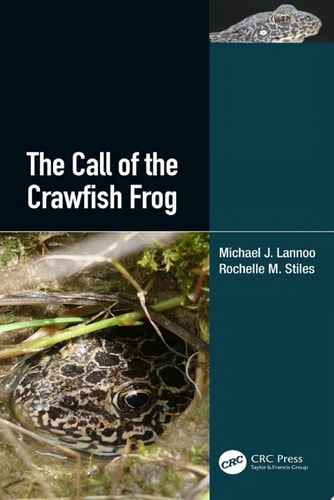
The Call of the Crawfish Frog
0
0
As an Amazon Associate and affiliate partner, Menrva Books earns from qualifying purchases. Learn more
Author Description
Crawfish Frogs (Rana areolata) have been called the most secretive frog in North America, and it is unusual in the twenty-first century - in the most scientifically advanced country in the world - that basic discoveries can still be made on an animal that inhabits a quarter of the United States. This is not only a story of the biology of Crawfish Frogs, but a case study of discovery. This volume describes the life history and natural history critical to the survival of the endangered amphibian and recommends management actions to ensure persistence. The authors tell an optimistic conservation biology story and fill a gap between science and the public. The authors have compiled and summarized the peer-reviewed literature on the biology of Crawfish Frogs, which may be one of the most interesting frogs in North America (that nobody knows about). Key Features Recounts the story of an imperiled species and how to go about saving it Vividly brings science to life and makes it accessible Provides a popular account of natural history research and ecological fieldwork Related Titles D. Vieira de Andrade, C. R. Bevier & J. Eduardo de Carvalho, eds. Amphibian and Reptile Adaptations to the Environment: Interplay Between Physiology and Behavior (ISBN 978-1-4822-204-3). M. Ogielska, ed. Reproduction of Amphibians (ISBN 978-1-1381-1771-6). D. W. Sparling, G. Linder, C. A. Bishop & S. Krest, eds. Ecotoxicology of Amphibians and Reptiles, 2nd Edition (ISBN 978-1-4200-6416-2). F. L. Frye. Reptiles and Amphibians: Self-Assessment Color Review, Second Edition (ISBN 978-1-4822-5760-1).
Menrva's Summary
THE THESIS
This book investigates the life history and conservation of the secretive Crawfish Frog, an endangered amphibian inhabiting a quarter of the United States. The authors, Michael J. Lannoo and Rochelle M. Stiles, present a case study of scientific discovery, detailing how basic biological insights are still being made in the 21st century. The volume synthesizes peer-reviewed literature to describe the critical factors for the frog's survival and proposes management actions to ensure its persistence. It aims to bridge the gap between scientific research and public understanding, offering an optimistic perspective on conservation biology.
THE SCOPE MAP
- The biology and natural history of the Crawfish Frog (Rana areolata).
- The story of scientific discovery related to this species.
- Critical factors for the survival of this endangered amphibian.
- Recommended management actions for conservation.
- A synthesis of peer-reviewed literature on Crawfish Frogs.
- An optimistic conservation biology narrative.
THE AUTHORITY PERSPECTIVE
The book is presented as a valuable resource that fills a gap between scientific research and public accessibility, offering an optimistic outlook on conservation biology. It is designed to make natural history research and ecological fieldwork vivid and understandable. The work is positioned to appeal to those interested in endangered species and the process of scientific discovery.
Page Count:
202
Publication Date:
2020-03-31
Publisher:
Taylor & Francis Limited (Sales)
ISBN-10:
0367456354
ISBN-13:
9780367456351
Science
Animals
Nature
Non-Fiction
Community Tags
Other Editions(5)


Similar Books











Reader Comments
Share Your Thoughts
No comments yet. Be the first to share your thoughts!