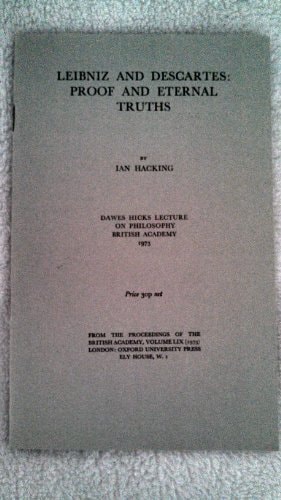
Leibniz and Descartes: Proof and Eternal Truths
0
0
As an Amazon Associate and affiliate partner, Menrva Books earns from qualifying purchases. Learn more
Author Description
The book is an epistemological distinction betwen Leibniz and Descartes in how they varied with proofs and eternal truths. It seeks to draw similarities and differences of their doctrines by comparison and contrast. Hacking's focus throughout is philosophy of mathematics and prehistory in the context of content and form. As the title asserts topics include proofs- finite and infinite. Eternal truth through geometrical and algebraic dialogue, in the first time in history according to Hacking, offers evidence of proofs. A short yet dense read of two great philosophers.
Menrva's Summary
THE THESIS
This work investigates the fundamental epistemological divergence between Leibniz and Descartes regarding the nature of mathematical proof and the status of eternal truths. Ian Hacking, a prominent philosopher of science, utilizes a comparative analysis of these two thinkers to examine how their respective doctrines on necessity and contingency shaped early modern philosophy. By situating their arguments within the context of geometrical and algebraic development, Hacking provides a rigorous framework for understanding the transition from classical to modern mathematical thought.
THE SCOPE MAP
What You Will Find
- Comparative analysis of Cartesian and Leibnizian epistemological frameworks.
- Examination of the role of finite and infinite proofs in mathematical logic.
- Historical context regarding the emergence of algebraic versus geometrical methodologies.
- Analysis of the conceptual shift in the definition of eternal truths.
THE AUTHORITY PERSPECTIVE
Experts recognize this lecture as a concise yet highly dense contribution to the study of early modern rationalism. Readers frequently note the academic rigor of the prose, which serves as a foundational text for those interested in the intersection of mathematical history and philosophy.
Page Count:
16
Publication Date:
1973-01-01
Publisher:
Oxford University Press
ISBN-10:
0197256988
ISBN-13:
9780197256985
Philosophy
Evidence
Epistemology
Mathematics
Logic
Community Tags
Similar Books