
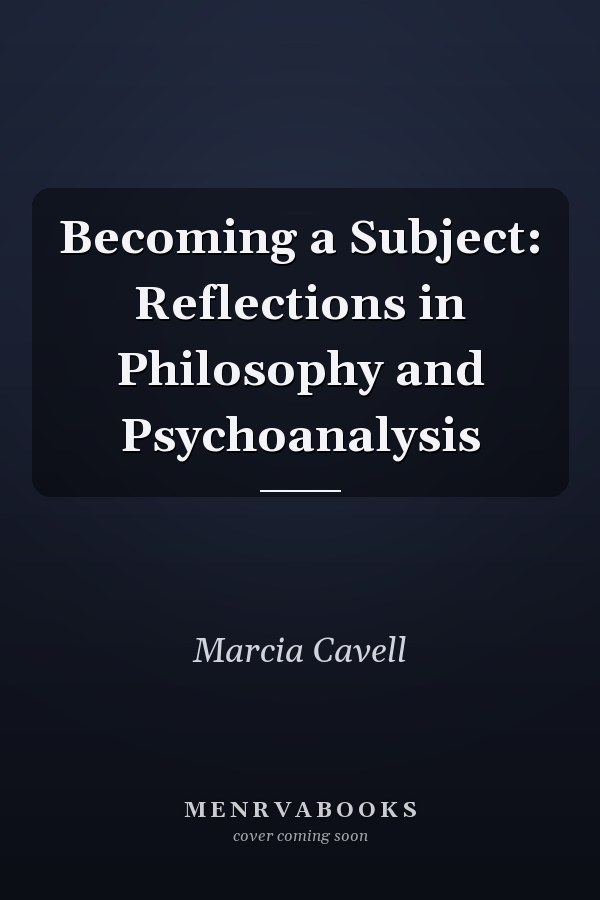
Becoming a Subject: Reflections in Philosophy and Psychoanalysis
0
0
As an Amazon Associate and affiliate partner, Menrva Books earns from qualifying purchases. Learn more
Author Description
Marcia Cavell draws on philosophy, psychoanalysis, and the sciences of the mind in a fascinating and original investigation of human subjectivity. A 'subject' is a creature, we may say, who recognizes herself as an 'I', taking in the world from her own subjective perspective; who is an agent, doing things for reasons, sometimes self-reflective, and able to assume responsibility for herself and some of her actions. The idea of a 'subject' points, then, toward an ideal. It asks for the conditions under which a human infant becomes a subject, and for the sorts of things, like self-deception and massive anxiety, that get in the way. What sorts of questions are these? Certainly philosophical. They burrow into central issues in moral philosophy: freedom of the will, the 'self', self-knowledge, the relations between reason and passion, between autonomy and self-knowledge, issues that form roughly the second half of the book. They lead also into metaphysics and epistemology: Is subjectivity incompatible with objectivity? Are subjects not also objects in the real world? As such, how are they to be treated? Would it be possible, in theory, for a creature to become a subject in the absence of relationships with other subjects? But the questions are also practical. In particular they are at the heart of psychoanalysis both as a theory of the mind, and as a therapy which aims at maximizing the ideals of autonomy and self-knowledge implicit in the very idea of a 'subject'. One of the guiding premises of Becoming a Subject is that philosophical investigation into the specifically human way of being in the world cannot separate itself from investigations of a more empirical sort. Cavell brings together for the first time reflections in philosophy, findings in neuroscience, studies in infant development, psychoanalytic theory, and clinical vignettes from her own psychoanalytic practice.
Menrva's Summary
THE THESIS
This work investigates the conditions necessary for a human infant to develop into a self-reflective subject capable of agency and moral responsibility. Marcia Cavell, a philosopher and psychoanalyst, synthesizes findings from neuroscience, developmental psychology, and clinical practice to bridge the gap between abstract philosophical inquiry and empirical mind sciences. She argues that the development of subjectivity is inseparable from interpersonal relationships and that psychoanalysis serves as a practical framework for fostering the autonomy inherent in the concept of the subject.
THE SCOPE MAP
What You Will Find
- Analysis of moral philosophy concepts including free will, self-knowledge, and the relationship between reason and passion
- Integration of neuroscientific data with psychoanalytic theory
- Examination of developmental milestones in human infancy
- Clinical vignettes derived from the author's own psychoanalytic practice
Scope Limits
- The text does not provide a comprehensive history of psychoanalytic schools of thought
- It does not offer a clinical manual for practitioners but rather a theoretical exploration of subjectivity
THE AUTHORITY PERSPECTIVE
Scholars and practitioners recognize this text as a significant interdisciplinary bridge between analytic philosophy and clinical psychoanalysis. Readers frequently note the intellectual density of the prose, which requires a foundational understanding of both philosophical discourse and psychological theory.
Page Count:
192
Publication Date:
2006-01-01
Publisher:
Oxford University Press
ISBN-10:
0191536903
ISBN-13:
9780191536908
Psychology
Philosophy
Psychoanalysis
Metaphysics
Epistemology
Mind & Body
Neuroscience
Psychoanalysis philosophy
Community Tags
Other Editions(2)
Similar Books












Reader Comments
Share Your Thoughts
No comments yet. Be the first to share your thoughts!