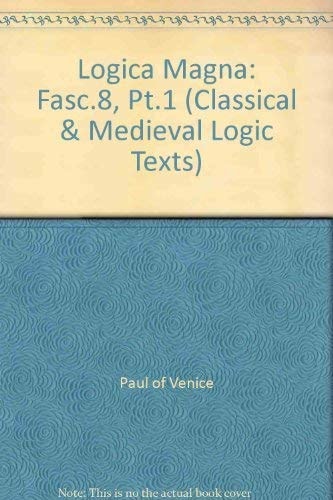
Logica Magna: Part I Fascicule 8: Tractatus de Necessitate et Contingentia Futurorum
0
0
As an Amazon Associate and affiliate partner, Menrva Books earns from qualifying purchases. Learn more
Author Description
Paul of Venice's Logica Magna is an invaluable repository for 14th-century logical theories. In this treatise on necessity and contingency, Paul gathers together a wide range of arguments on the question of whether the future is already determined (specifically, whether the proposition that Antichrist will come into existence is necessarily true). The arguments display great variety, taking in operatoru-shift fallacies, philosophical views on time, Aristotelian science, and theological considerations on foreknowledge and prophecy.
Menrva's Summary
THE THESIS
This volume investigates the logical and metaphysical status of future contingent propositions, specifically questioning whether future events are predetermined or necessary. Paul of Venice, a prominent 14th-century scholastic philosopher, synthesizes a vast array of medieval arguments to address the tension between divine foreknowledge and human contingency. The text employs rigorous scholastic methodology to evaluate the truth-value of propositions concerning future events, such as the arrival of the Antichrist. By examining these arguments, the author provides a comprehensive framework for understanding how medieval thinkers reconciled Aristotelian logic with theological doctrines of prophecy and time.
THE SCOPE MAP
What You Will Find
- Analysis of 14th-century logical theories regarding necessity and contingency
- Examination of operator-shift fallacies in modal logic
- Integration of Aristotelian scientific principles with theological discourse
- Evaluation of the relationship between divine foreknowledge and temporal truth
THE AUTHORITY PERSPECTIVE
Scholars of medieval philosophy recognize this text as a foundational resource for understanding the complexity of scholastic modal logic. Readers frequently note the high level of technical density in the prose, which requires a strong background in formal logic to fully navigate.
Page Count:
288
Publication Date:
1991-06-13
Publisher:
Oxford University Press
ISBN-10:
0197261019
ISBN-13:
9780197261019
Philosophy
Logic
Logic Ancient
Logic Medieval
Theology
Community Tags
Similar Books