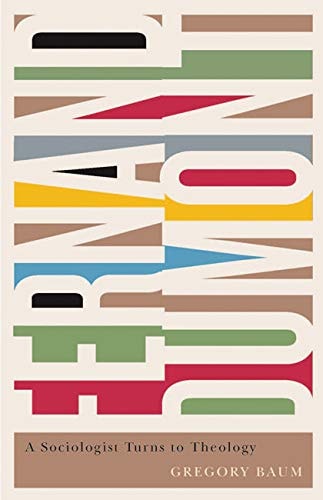
Fernand Dumont: A Sociologist Turns to Theology
0
0
As an Amazon Associate and affiliate partner, Menrva Books earns from qualifying purchases. Learn more
Author Description
Fernand Dumont (1927-1997) was a sociologist, philosopher, theologian, and poet. A prominent intellectual in Quebec, he is recognized for his research on the sociology of knowledge and the foundations of modern culture. Dumont's work conceives of culture in terms of both memory and distance, arguing that without culture, man would be immersed in the monotony of his present actions, never achieving the distance necessary to create a past or a future. In Fernand Dumont: A Sociologist Turns to Theology, Gregory Baum interprets Dumont's L'institution de la théologie, which studies the assumptions and commitments implicit in the rational reflection of Catholic thinkers on the meaning of their faith. Baum shows that while Dumont's book is preoccupied with the theoretical, its methodology is informed by the cognitive presuppositions of the social sciences, and its contents - dealing with the spiritual, personal, and social struggles that constitute daily life - are concrete. For Dumont religious truth is insufficient, and may have no impact on everyday life. What counts is relevance, insights that reply to urgent questions and unresolved conflicts. He offers an innovative interpretation of Catholicism that is faithful to the Gospel and relevant to the problems of modern life and the serious questions Quebecers are asking themselves. In Fernand Dumont: A Sociologist Turns to Theology, Baum elucidates Dumont's main ideas and connects the concerns of the Christian gospel with those of contemporary society.
Menrva's Summary
THE THESIS
This book examines the theological turn of a prominent Quebecois intellectual, Fernand Dumont, through the lens of his sociological and philosophical work. Gregory Baum interprets Dumont's seminal text, L'institution de la théologie, demonstrating how Dumont's background in the social sciences informed his analysis of Catholic thought. The work explores Dumont's conception of culture as a dynamic interplay of memory and distance, essential for human meaning-making. Baum highlights Dumont's insistence that religious truth must be relevant and impactful, addressing the urgent questions and conflicts of contemporary life.
THE SCOPE MAP
- Analysis of Fernand Dumont's L'institution de la théologie
- Exploration of Dumont's sociology of knowledge and its application to theology
- Examination of Dumont's concept of culture as memory and distance
- Discussion of the relevance of religious truth to modern life and societal issues
- Interpretation of Dumont's innovative approach to Catholicism
- Connection between the Christian gospel and contemporary societal concerns
- Focus on the cognitive presuppositions of social sciences informing theological reflection
THE AUTHORITY PERSPECTIVE
Gregory Baum's interpretation of Fernand Dumont's work is presented as a bridge between sociological inquiry and theological reflection. The book is framed as illuminating Dumont's key ideas, particularly his emphasis on the relevance of faith to contemporary life and the specific questions faced by Quebecers. Baum's analysis aims to demonstrate how Dumont's thought offers an innovative perspective on Catholicism that remains faithful to its origins while engaging with modern challenges. The work is positioned as a significant contribution to understanding Dumont's intellectual legacy and his impact on Quebecois thought.
Page Count:
138
Publication Date:
2015-01-01
Publisher:
McGill-Queen's University Press
ISBN-10:
0773545425
ISBN-13:
9780773545427
Biography
Non-Fiction
Intellectual History
Theology
Sociology
Community Tags
Similar Books