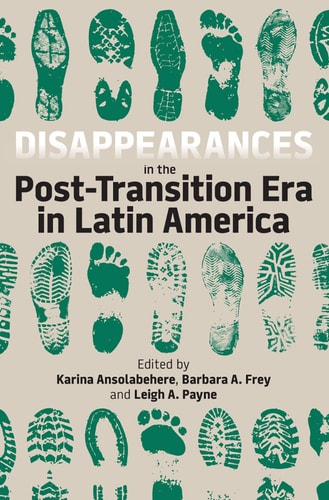
Disappearances in the Post-Transition Era in Latin America
0
0
As an Amazon Associate and affiliate partner, Menrva Books earns from qualifying purchases. Learn more
Author Description
Latin America sits at the centre of the third wave of democratisation beginning in the early 1980s. It has advanced farther than any other region of the world in its accountability processes for past human rights violations perpetrated during authoritarian regimes and armed conflicts. Despite these human rights achievements, Latin America is known as the most violent global region. In the last two decades since the transitions, serious human rights violations, especially disappearances, have increased exponentially in several countries in the region.This volume seeks to understand these post-transition disappearances. It does so by examining four different countries and the dynamics that play out there. It considers a variety of voices and points of view: those expressing the experiences from the perspectives of victims and relatives; those of activists, advocates, and public officials seeking truth and justice; and those from scholars attempting to draw out the specificities in each case and the patterns across cases. The underlying objective behind the project to gain knowledge and to draw on deep commitment to change within the region is to overcome this tragedy.After reading this volume, readers will not only have an overview of the practice of disappearances in the region, but will also be able to gauge how, despite the differences, the social and political logics that make disappearances possible are similar. The disappearances of the past and those of present are not the same, and it would be a mistake to consider them that way, but the social practices that make them possible are similar. These practices are what we call the logics of disappearance.
Menrva's Summary
THE THESIS
This volume investigates the persistent and evolving phenomenon of forced disappearances in Latin America during the post-transition era, questioning how democratic regimes continue to facilitate such human rights violations. The authors, including Ansolabehere, Frey, and Payne, synthesize academic research with the lived experiences of victims, activists, and public officials to analyze the structural conditions that allow these practices to endure. By comparing four distinct national contexts, the text argues that while the political landscape has shifted since the 1980s, the underlying social and political logics enabling disappearances remain alarmingly consistent. The work serves as both a scholarly inquiry into regional violence and a call for systemic accountability.
THE SCOPE MAP
What You Will Find
- Comparative analysis of disappearance dynamics across four Latin American nations.
- Examination of the social and political logics that facilitate human rights violations in post-transition democracies.
- Qualitative evidence derived from interviews with victims, relatives, activists, and public officials.
- A framework for distinguishing between historical authoritarian disappearances and contemporary post-transition cases.
THE AUTHORITY PERSPECTIVE
Experts recognize this volume as a critical contribution to the study of transitional justice and human rights in the Global South. Readers frequently note the academic density of the prose, which provides a rigorous, evidence-based examination of regional political violence.
Page Count:
304
Publication Date:
2021-08-24
Publisher:
Oxford University Press
ISBN-10:
019726722X
ISBN-13:
9780197267226
History
Human rights
Sociology
Community Tags
Similar Books