Bayes's Theorem
0
0
As an Amazon Associate and affiliate partner, Menrva Books earns from qualifying purchases. Learn more
Author Description
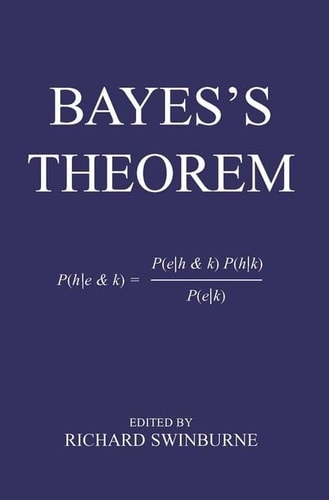
Bayes's theorem is a tool for assessing how probable evidence makes some hypothesis. The papers in this volume consider the worth and applicability of the theorem. Richard Swinburne sets out the philosophical issues. Elliott Sober argues that there are other criteria for assessing hypotheses. Colin Howson, Philip Dawid and John Earman consider how the theorem can be used in statistical science, in weighing evidence in criminal trials, and in assessing evidence for the occurrence of miracles. David Miller argues for the worth of the probability calculus as a tool for measuring propensities in nature rather than the strength of evidence. The volume ends with the original paper containing the theorem, presented to the Royal Society in 1763.
Menrva's Summary
THE THESIS
This volume investigates the philosophical validity, mathematical utility, and practical application of Bayes's theorem across diverse fields of inquiry. Editor Richard Swinburne compiles a series of academic papers that examine the theorem's role in hypothesis assessment, statistical science, and evidentiary reasoning. The contributors analyze whether the theorem serves as a reliable measure for the strength of evidence or if alternative criteria are required for scientific and legal evaluation. The collection concludes with the historical context of the original 1763 paper presented to the Royal Society.
THE SCOPE MAP
What You Will Find
- Philosophical frameworks regarding the assessment of evidence and hypothesis testing
- Applications of Bayesian probability in statistical science and criminal trials
- Critical analysis of the theorem's utility in evaluating historical or anomalous events such as miracles
- A historical reproduction of the original 1763 paper by Thomas Bayes
THE AUTHORITY PERSPECTIVE
Experts identify this collection as a significant resource for those interested in the intersection of probability theory and epistemology. Readers frequently note the academic density of the prose, which is intended for scholars and students familiar with formal logic and statistical methodology.
Page Count:
160
Publication Date:
2005-07-12
Publisher:
Oxford University Press
ISBN-10:
0197263410
ISBN-13:
9780197263419
History
Science
Philosophy
Politics
Probability
Statistics
New Used & Rental Textbooks
Mathematics
Logic
Applied