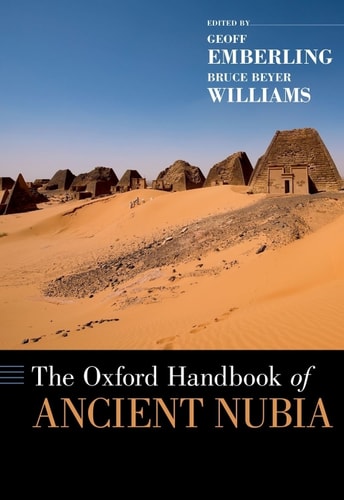
The Oxford Handbook of Ancient Nubia
0
0
As an Amazon Associate and affiliate partner, Menrva Books earns from qualifying purchases. Learn more
Author Description
The cultures of Nubia built the earliest cities, states, and empires of inner Africa, but they remain relatively poorly known outside their modern descendants and the community of archaeologists, historians, and art historians researching them. The earliest archaeological work in Nubia was motivated by the region's role as neighbor, trade partner, and enemy of ancient Egypt. Increasingly, however, ancient Nile-based Nubian cultures are recognized in their own right as the earliest complex societies in inner Africa. As agro-pastoral cultures, Nubian settlement, economy, political organization, and religious ideologies were often organized differently from those of the urban, bureaucratic, and predominantly agricultural states of Egypt and the ancient Near East. Nubian societies are thus of great interest in comparative study, and are also recognized for their broader impact on the histories of the eastern Mediterranean and the Near East. The Oxford Handbook of Ancient Nubia brings together chapters by an international group of scholars on a wide variety of topics that relate to the history and archaeology of the region. After important introductory chapters on the history of research in Nubia and on its climate and physical environment, the largest part of the volume focuses on the sequence of cultures that lead almost to the present day. Several cross-cutting themes are woven through these chapters, including essays on desert cultures and on Nubians in Egypt. Eleven final chapters synthesize subjects across all historical phases, including gender and the body, economy and trade, landscape archaeology, iron working, and stone quarrying.
Menrva's Summary
THE THESIS
This volume investigates the historical and archaeological development of ancient Nubia, positioning it as a distinct and complex society independent of its neighbor, ancient Egypt. Editors Bruce Williams and Geoff Emberling curate contributions from an international cohort of scholars to re-evaluate Nubian political, economic, and religious structures. By synthesizing decades of research, the text argues that Nubian cultures represent the earliest complex societies in inner Africa, necessitating a shift in comparative historical study.
THE SCOPE MAP
What You Will Find
- A comprehensive chronological sequence of Nubian cultures from antiquity to the modern era.
- Analysis of environmental factors, including climate and physical geography, on societal development.
- Comparative studies of Nubian agro-pastoralism versus Egyptian bureaucratic state models.
- Thematic examinations of specialized topics such as iron working, gender, landscape archaeology, and trade networks.
THE AUTHORITY PERSPECTIVE
Experts recognize this volume as a foundational reference for the study of the Nile Valley, providing a necessary corrective to Egypt-centric historical narratives. Readers frequently note the academic density of the prose, which serves as a rigorous resource for historians and archaeologists alike.
Page Count:
1215
Publication Date:
2020-01-01
Publisher:
Oxford University Press
ISBN-10:
0197521835
ISBN-13:
9780197521830
History
Africa
Middle Eastern
Anthropology
Ancient History
Archaeology
Africa - History