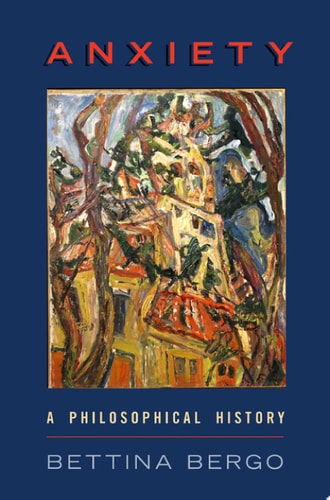
Anxiety: A Philosophical History
0
0
As an Amazon Associate and affiliate partner, Menrva Books earns from qualifying purchases. Learn more
Author Description
Anxiety looms large in historical works of philosophy and psychology. It is an affect, philosopher Bettina Bergo argues, subtler and more persistent than our emotions, and points toward the intersection of embodiment and cognition. While scholars who focus on the work of luminaries as Freud, Levinas, or Kant often study this theme in individual works, they seldom draw out the deep and significant connections between various approaches to anxiety. This volume provides a sweeping study of the uncanny career of anxiety in nineteenth and twentieth century European thought. Anxiety threads itself through European intellectual life, beginning in receptions of Kant's transcendental philosophy and running into Levinas' phenomenology; it is a core theme in Schelling, Kierkegaard, Schopenhauer, and Nietzsche. As a symptom of an interrogation that strove to take form in European intellectual culture, Angst passes through Schelling's romanticism into Schopenhauer's metaphysical vitalism, before it is explored existentially by Kierkegaard. And, in the twentieth century, it proves an extremely central concept for Heidegger, even as Freud is exploring its meaning and origin over a thirty year-long period of psychoanalytic development. This volume opens new windows onto philosophers who have never yet been put into dialogue, providing a rigorous intellectual history as it connects themes across two centuries, and unearths the deep roots of our own present-day "age of anxiety."
Menrva's Summary
THE THESIS
This book investigates the historical evolution and philosophical significance of anxiety as a persistent affect within European intellectual thought. Author Bettina Bergo, a scholar of philosophy, synthesizes two centuries of discourse to argue that anxiety serves as a critical intersection between human embodiment and cognition. By tracing the concept from Kantian transcendental philosophy through the phenomenological inquiries of the twentieth century, Bergo establishes a cohesive framework that links disparate thinkers who have rarely been analyzed in direct dialogue.
THE SCOPE MAP
What You Will Find
- A comprehensive survey of anxiety in nineteenth and twentieth-century European philosophy.
- Comparative analysis of key figures including Kant, Schelling, Kierkegaard, Schopenhauer, Nietzsche, Freud, and Heidegger.
- An examination of the transition of 'Angst' from romanticism and metaphysical vitalism to existential phenomenology.
- A historical synthesis connecting intellectual developments to the contemporary cultural preoccupation with anxiety.
THE AUTHORITY PERSPECTIVE
Scholars and readers frequently note the academic density and rigorous historical scope of this text. Experts highlight this work as a significant contribution to the history of ideas, particularly for its ability to bridge the gap between psychoanalytic theory and continental philosophy.
Page Count:
532
Publication Date:
2020-01-01
Publisher:
Oxford University Press
ISBN-10:
0197539734
ISBN-13:
9780197539736
Non-Fiction
Psychology
Philosophy
Mind & Body
Phenomenology
Intellectual History
Mental Illness
Anxiety
European History
History & Surveys
History of Psychology
Community Tags
Similar Books