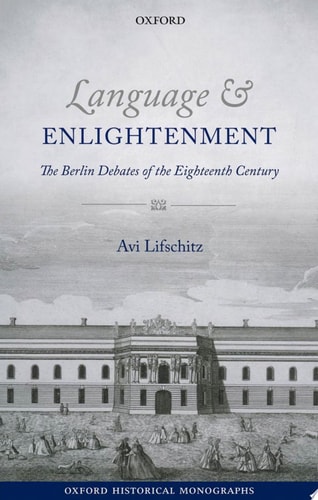
Language and Enlightenment: The Berlin Debates of the Eighteenth Century
0
0
As an Amazon Associate and affiliate partner, Menrva Books earns from qualifying purchases. Learn more
Author Description
What Is The Role Of Language In Human Cognition? Could We Attain Self-consciousness And Construct Our Civilization Without Language? Such Were The Questions At The Basis Of Eighteenth-century Debates On The Joint Evolution Of Language, Mind, And Culture. Language And Enlightenment Highlights The Importance Of Language In The Social Theory, Epistemology, And Aesthetics Of The Enlightenment. While Focusing On The Berlin Academy Under Frederick The Great, Avi Lifschitz Situates The Berlin Debates Within A Larger Temporal And Geographical Framework. He Argues That Awareness Of The Historicity And Linguistic Rootedness Of All Forms Of Life Was A Mainstream Enlightenment Notion Rather Than A Feature Of The So-called 'counter-enlightenment'. Enlightenment Authors Of Different Persuasions Investigated Whether Speechless Human Beings Could Have Developed Their Language And Society On Their Own. Such Inquiries Usually Pondered The Difficult Shift From Natural Signs Like Cries And Gestures To The Artificial, Articulate Words Of Human Language. This Transition From Nature To Artifice Was Mirrored In Other Domains Of Inquiry, Such As The Origins Of Social Relations, Inequality, The Arts, And The Sciences. By Examining A Wide Variety Of Authors - Leibniz, Wolff, Condillac, Rousseau, Michaelis, And Herder, Among Others - Language And Enlightenment Emphasises The Open And Malleable Character Of The Eighteenth-century Republic Of Letters. The Language Debates Demonstrate That German Theories Of Culture And Language Were Not Merely A Rejection Of French Ideas. New Notions Of The Genius Of Language And Its Role In Cognition Were Constructed Through A Complex Interaction With Cross-european Currents, Especially Via The Prize Contests At The Berlin Academy.
Menrva's Summary
THE THESIS
This book investigates the central role of language in eighteenth-century theories of human cognition, social development, and cultural evolution. Avi Lifschitz, a scholar of intellectual history, utilizes primary source documents from the Berlin Academy and broader European philosophical texts to challenge the traditional dichotomy between the Enlightenment and the so-called Counter-Enlightenment. He argues that the recognition of language as a historical and social construct was a fundamental component of mainstream Enlightenment thought rather than a peripheral or reactionary development.
THE SCOPE MAP
What You Will Find
- Analysis of the Berlin Academy prize contests under Frederick the Great
- Comparative study of philosophers including Leibniz, Wolff, Condillac, Rousseau, and Herder
- Examination of the transition from natural signs to artificial language
- Discussion of the intersection between linguistics, epistemology, and social inequality
Scope Limits
- The text does not provide a comprehensive history of all European linguistic theories of the era
- It does not focus on the practical application of language pedagogy during the eighteenth century
THE AUTHORITY PERSPECTIVE
Scholars and historians of philosophy frequently cite this work as a rigorous re-evaluation of the intellectual exchanges between German and French thinkers during the Enlightenment. Experts highlight the book's ability to synthesize complex linguistic debates into a coherent narrative regarding the evolution of human self-consciousness.
Page Count:
244
Publication Date:
2012-01-01
Publisher:
Oxford University Press
ISBN-10:
0191637750
ISBN-13:
9780191637759
Philosophy
History
Language And Culture
Intellectual History
European History
Linguistics
Enlightenment
Social Aspects
Community Tags
Other Editions(3)

Similar Books







Reader Comments
Share Your Thoughts
No comments yet. Be the first to share your thoughts!