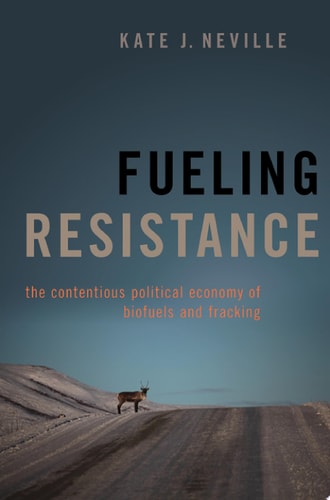
Fueling Resistance: The Contentious Political Economy of Biofuels and Fracking
0
0
As an Amazon Associate and affiliate partner, Menrva Books earns from qualifying purchases. Learn more
Author Description
A series of concurrent pressures in the early 2000s--climate change, financial system crashes, economic development in rural regions, and shifts in geopolitics--intensified interest in alternative energy production. At the same time, rising oil prices rendered alternative fuels a more economically viable option. Among these energy sources, liquid biofuels (bioethanol and biodiesel) and natural gas derived from hydraulic fracturing ("fracking") took center stage as promising commodities and technologies. But controversy quickly erupted in surprisingly similar ways around both renewable fuels. Global enthusiasm for these fuels--and the widespread projections for their production around the world--collided with local politics in debates over "food versus fuel" and concerns over "land grabs." What seemed, from a global perspective, like empty lands ripe for development were, to rural communities, vibrant and already contested spaces. As proposals for biofuels and fracking landed in specific communities and ecosystems, they reignited and reshaped old disputes over land, water, and decision-making authority. Fueling Resistance offers an account of how and why controversies over these different fuels unfolded in surprisingly similar ways in the global North and South. To explain these convergent dynamics of contention and resistance, Kate J. Neville argues that the emergence of grievances and the patterns of resistance to new fuel technologies depends less on the type of energy developed (renewable versus fossil fuel) than on intersecting elements of the political economy of energy: finance, ownership, and trade relations. As local commodities enter global supply chains and are integrated into existing corporate structures, opportunities arise to broker connections between otherwise disparate communities. Neville looks at biofuels in Kenya and fracking in the Canadian Yukon and shows how organizers connect specific energy projects to broader issues of globalization, climat
Menrva's Summary
THE THESIS
This book investigates why controversies surrounding biofuels and hydraulic fracturing exhibit remarkably similar patterns of local resistance despite their distinct origins as renewable or fossil fuel technologies. Kate J. Neville, an expert in environmental policy and political economy, utilizes a comparative framework to analyze how global energy projects interact with local governance. She argues that the nature of the energy source is secondary to the underlying political economy—specifically finance, ownership, and trade relations—in determining how communities organize against industrial expansion.
THE SCOPE MAP
What You Will Find
- Comparative analysis of biofuel development in Kenya and fracking operations in the Canadian Yukon.
- Examination of the intersection between global supply chains and local land-use disputes.
- Evaluation of the 'food versus fuel' debate and its impact on rural resource management.
- Theoretical framework linking corporate ownership structures to the emergence of grassroots political mobilization.
THE AUTHORITY PERSPECTIVE
Scholars in the field of political ecology identify this work as a significant contribution to understanding the localized impacts of global energy transitions. Readers frequently note the academic rigor of the comparative methodology, which effectively bridges the gap between environmental science and political economy.
Page Count:
263
Publication Date:
2021-01-01
Publisher:
Oxford University Press
ISBN-10:
0197535607
ISBN-13:
9780197535608
Economics
Energy policy
Public Policy
Globalization
Sociology
Biomass Energy
Community Tags
Other Editions(2)
Similar Books











Reader Comments
Share Your Thoughts
No comments yet. Be the first to share your thoughts!