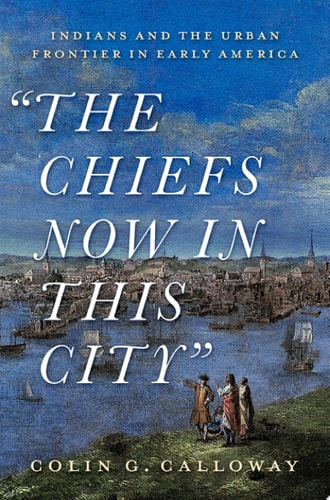
The Chiefs Now in This City: Indians and the Urban Frontier in Early America
0
0
As an Amazon Associate and affiliate partner, Menrva Books earns from qualifying purchases. Learn more
Author Description
During the years of the Early Republic, prominent Native leaders regularly traveled to American cities--Albany, Boston, Charleston, Philadelphia, Montreal, Quebec, New York, and New Orleans--primarily on diplomatic or trade business, but also from curiosity and adventurousness. They were frequently referred to as "the Chiefs now in this city" during their visits, which were sometimes for extended periods of time. Indian people spent a lot of time in town. Colin Calloway, National Book Award finalist and one of the foremost chroniclers of Native American history, has gathered together the accounts of these visits and from them created a new narrative of the country's formative years, redefining what has been understood as the "frontier." Calloway's book captures what Native peoples observed as they walked the streets, sat in pews, attended plays, drank in taverns, and slept in hotels and lodging houses. In the Eastern cities they experienced an urban frontier, one in which the Indigenous world met the Atlantic world. Calloway's book reveals not just what Indians saw but how they were seen. Crowds gathered to see them, sometimes to gawk; people attended the theatre to watch “the Chiefs now in this city” watch a play.Their experience enriches and redefines standard narratives of contact between the First Americans and inhabitants of the American Republic, reminding us that Indian people dealt with non-Indians in multiple ways and in multiple places. The story of the country's beginnings was not only one of violent confrontation and betrayal, but one in which the nation's identity was being forged by interaction between and among cultures and traditions.
Menrva's Summary
THE THESIS
This work investigates the overlooked role of Native American leaders within the urban centers of the Early American Republic, challenging the traditional binary of the frontier. Colin Calloway, a distinguished historian of Native American history, synthesizes primary source accounts of diplomatic and personal visits by Indigenous peoples to cities such as Philadelphia, New York, and New Orleans. By examining these urban interactions, Calloway argues that the formative years of the United States were defined as much by cross-cultural exchange and observation as they were by territorial conflict. The book provides a framework for understanding the urban frontier as a site where the Indigenous world and the Atlantic world intersected.
THE SCOPE MAP
What You Will Find
- Historical analysis of Native American diplomatic and personal travel to major Eastern cities during the Early Republic.
- Examination of the social dynamics and mutual observations between Indigenous visitors and urban inhabitants.
- Utilization of primary source accounts, including journals, newspaper reports, and travelogues.
- A re-evaluation of the American frontier concept, shifting the focus from the wilderness to the urban landscape.
THE AUTHORITY PERSPECTIVE
Historians and scholars of early American history frequently cite this work for its ability to shift the focus of frontier studies toward the urban experience. Experts highlight the text as a significant contribution to the field for its nuanced portrayal of Indigenous agency in the face of colonial expansion.
Page Count:
283
Publication Date:
2021-01-01
Publisher:
Oxford University Press
ISBN-10:
0197547672
ISBN-13:
9780197547670
History
Urban History
History of the Americas
United States
American History
Modern History
Cultural History
Community Tags
Similar Books