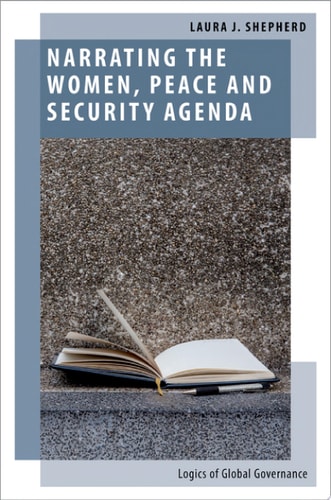
Narrating the Women, Peace and Security Agenda: Logics of Global Governance
0
0
As an Amazon Associate and affiliate partner, Menrva Books earns from qualifying purchases. Learn more
Author Description
The "narrative turn" has recently influenced theories, methods, and research design within the field of international relations. Its goal is, in part, to show how stories about international events and issues emerge and develop, and how these stories influence the uptake and limitations of global policy "solutions" around the world. Through the lens of narrative, this book examines the Women, Peace and Security (WPS) agenda, adopted by the United Nations Security Council twenty years ago. The agenda seeks to increase the participation of women in conflict prevention efforts and to protect the rights of women during conflict and peacebuilding. Those involved in the creation of the WPS agenda, including its strategies, guidelines, and protocols, tend to assume that implementation is the most critical element of it. But what can the stories about the agenda's emergence tell us about its limits and possibilities? Laura J. Shepherd examines WPS as a policy agenda that has been realized in and through the stories that have been told about it, focusing on the world of WPS work at the United Nations Headquarters in New York. She argues that to understand the implementation of the agenda we need to also understand the narration of the agenda's beginnings, its ongoing unfolding, and its plural futures. These stories outline the agenda's priorities and delimit its possibilities--as well as communicate and constitute its triumphs and disasters. As the book shows, much energy and resources are expended in efforts to reduce or resolve the agenda to a singular, essential "thing"--with singular, essential meaning. There is no "true" WPS agenda that practitioners, activists, and policymakers can apprehend and use as their guide; there is only a messy and contested space for political interventions of different kinds. Shepherd shows that the narratives of the WPS agenda incorporate plural logics but that this plurality cannot--should not--be used as an alibi for limited engagement or
Menrva's Summary
THE THESIS
How do the narratives surrounding the United Nations Women, Peace and Security (WPS) agenda shape its implementation and define its global policy limits? Laura J. Shepherd, a scholar in international relations and gender studies, utilizes a narrative-focused framework to analyze the development of the WPS agenda over its twenty-year history. She argues that the agenda is not a static policy but a contested space constructed through the stories told by practitioners, activists, and policymakers at the United Nations. By examining these narratives, Shepherd demonstrates how the agenda's meaning is constantly negotiated, revealing both its potential for progress and the structural constraints that limit its efficacy.
THE SCOPE MAP
What You Will Find
- An analysis of the narrative turn within international relations theory and its application to global governance.
- A detailed examination of the Women, Peace and Security agenda as a discursive construct rather than a singular policy.
- Qualitative research based on observations and interactions within the United Nations Headquarters in New York.
- A critical exploration of how institutional storytelling influences the priorities and failures of international peacebuilding efforts.
THE AUTHORITY PERSPECTIVE
Experts in international relations and gender studies identify this work as a significant contribution to the critical analysis of global policy frameworks. Readers frequently note the academic density of the prose, which is well-suited for scholars and practitioners interested in the intersection of discourse and institutional practice.
Page Count:
208
Publication Date:
2021-01-01
Publisher:
Oxford University Press
ISBN-10:
0197557279
ISBN-13:
9780197557273
International relations
Sociology
Gender Studies
Human rights
Community Tags
Other Editions(2)
Similar Books









Reader Comments
Share Your Thoughts
No comments yet. Be the first to share your thoughts!