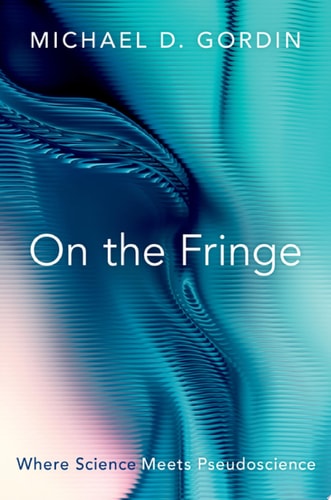
On the Fringe: Where Science Meets Pseudoscience
0
0
As an Amazon Associate and affiliate partner, Menrva Books earns from qualifying purchases. Learn more
Author Description
Everyone has heard of the term "pseudoscience", typically used to describe something that looks like science, but is somehow false, misleading, or unproven. Many would be able to agree on a list of things that fall under its umbrella-- astrology, phrenology, UFOlogy, creationism, and eugenics might come to mind. But defining what makes these fields "pseudo" is a far more complex issue. It has proved impossible to come up with a simple criterion that enables us to differentiate pseudoscience from genuine science. Given the virulence of contemporary disputes over the denial of climate change and anti-vaccination movements--both of which display allegations of "pseudoscience" on all sides-- there is a clear need to better understand issues of scientific demarcation.On the Fringe explores the philosophical and historical attempts to address this problem of demarcation. This book argues that by understanding doctrines that are often seen as antithetical to science, we can learn a great deal about how science operated in the past and does today. This exploration raises several questions: How does a doctrine become demonized as pseudoscientific? Who has the authority to make these pronouncements? How is the status of science shaped by political or cultural contexts? How does pseudoscience differ from scientific fraud?Michael D. Gordin both answers these questions and guides readers along a bewildering array of marginalized doctrines, looking at parapsychology (ESP), Lysenkoism, scientific racism, and alchemy, among others, to better understand the struggle to define what science is and is not, and how the controversies have shifted over the centuries. On the Fringe provides a historical tour through many of these fringe fields in order to provide tools to think deeply about scientific controversies both in the past and in our present.
Menrva's Summary
THE THESIS
This book investigates the historical and philosophical challenges of defining the boundary between legitimate science and pseudoscience. Michael D. Gordin, a professor of history at Princeton University, utilizes a historical framework to examine how various doctrines have been labeled as pseudoscientific over time. He argues that the demarcation problem is not merely a matter of logic, but a complex social and political process that reveals how scientific authority is constructed and contested.
THE SCOPE MAP
What You Will Find
- Historical analysis of marginalized doctrines including alchemy, phrenology, Lysenkoism, and parapsychology.
- Examination of the political and cultural factors that influence scientific status.
- Comparative study of scientific fraud versus fringe scientific theories.
- Theoretical framework for understanding contemporary controversies like climate change denial and anti-vaccination movements.
THE AUTHORITY PERSPECTIVE
Experts recognize this work as a significant contribution to the history and philosophy of science, noting its ability to clarify why the demarcation problem remains unresolved. Readers frequently highlight the accessible prose and the author's success in contextualizing complex historical debates for a modern audience.
Page Count:
130
Publication Date:
2021-01-01
Publisher:
Oxford University Press
ISBN-10:
0197555780
ISBN-13:
9780197555781
Philosophy
Non-Fiction
History
Science
Sociology
Special Topics
Community Tags
Similar Books