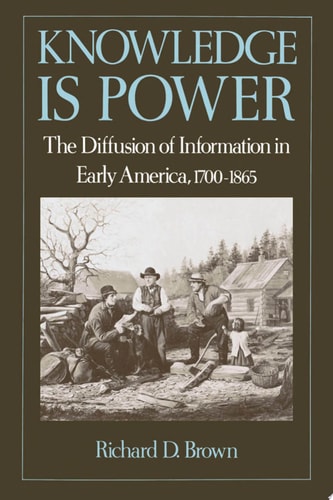
Knowledge Is Power: The Diffusion of Information in Early America, 1700-1865
0
0
As an Amazon Associate and affiliate partner, Menrva Books earns from qualifying purchases. Learn more
Author Description
Brown here explores America's first communications revolution--the revolution that made printed goods and public oratory widely available and, by means of the steamboat, railroad and telegraph, sharply accelerated the pace at which information travelled. He describes the day-to-day experiences of dozens of men and women, and in the process illuminates the social dimensions of this profound, far-reaching transformation. Brown begins in Massachusetts and Virginia in the early 18th century, when public information was the precious possession of the wealthy, learned, and powerful, who used it to reinforce political order and cultural unity. Employing diaries and letters to trace how information moved through society during seven generations, he explains that by the Civil War era, cultural unity had become a thing of the past. Assisted by advanced technology and an expanding economy, Americans had created a pluralistic information marketplace in which all forms of public communication--print, oratory, and public meetings--were competing for the attention of free men and women. Knowledge is Power provides fresh insights into the foundations of American pluralism and deepens our perspective on the character of public communications in the United States.
Menrva's Summary
THE THESIS
This work investigates the transformation of American society through the lens of a communications revolution that shifted information from a restricted elite resource to a pluralistic marketplace between 1700 and 1865. Richard D. Brown, a historian of early America, utilizes a vast array of primary source materials, including personal diaries and correspondence, to reconstruct the lived experience of information exchange. He argues that the rise of new technologies like the steamboat and telegraph, combined with economic expansion, dismantled the early colonial monopoly on public knowledge. This shift ultimately fostered the pluralistic cultural landscape that defined the United States by the onset of the Civil War.
THE SCOPE MAP
What You Will Find
- Analysis of the transition from elite-controlled information in 18th-century Massachusetts and Virginia to a competitive marketplace.
- Examination of the impact of technological advancements including the steamboat, railroad, and telegraph on information velocity.
- Qualitative evidence derived from personal diaries and letters of men and women across seven generations.
- Exploration of the decline of cultural unity and the rise of American pluralism through public oratory and print media.
THE AUTHORITY PERSPECTIVE
Historians and scholars of American culture frequently cite this text as a foundational study on the social history of communication. Readers often note the academic rigor and the depth of the archival research, which provides a detailed look at how information shaped the early American experience.
Page Count:
385
Publication Date:
2020-01-01
Publisher:
Oxford University Press
ISBN-10:
0197554997
ISBN-13:
9780197554999
History
Information Science
Communication Studies
American History
United States
Sociology
Cultural History
Community Tags
Other Editions(2)

Similar Books














