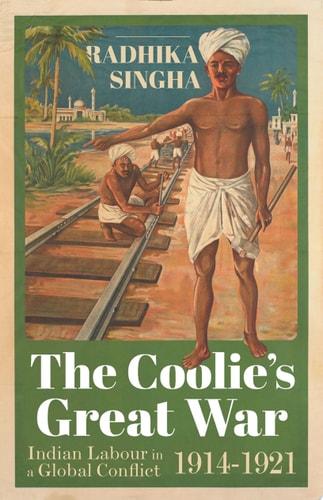
The Coolie's Great War: Indian Labour in a Global Conflict, 1914-1921
0
0
As an Amazon Associate and affiliate partner, Menrva Books earns from qualifying purchases. Learn more
Author Description
Though largely invisible in histories of the First World War, over 550,000 men in the ranks of the Indian army were non-combatants. From the porters, stevedores and construction workers in the Coolie Corps to those who maintained supply lines and removed the wounded from the battlefield, Radhika Singha recovers the story of this unacknowledged service.The labor regimes built on the backs of these 'coolies' sustained the military infrastructure of empire; their deployment in interregional arenas bent to the demands of global war. Viewed as racially subordinate and subject to 'non-martial' caste designations, they fought back against their status, using the warring powers' need for manpower as leverage to challenge traditional service hierarchies and wage differentials.The Coolie's Great War views that global conflict through the lens of Indian labor, constructing a distinct geography of the war--from tribal settlements and colonial jails, beyond India's frontiers, to the battlefronts of France and Mesopotamia.
Menrva's Summary
THE THESIS
This work investigates the critical, often overlooked role of Indian non-combatant laborers in sustaining the British military infrastructure during the First World War. Radhika Singha, a historian specializing in colonial India, utilizes extensive archival research to document the experiences of over 550,000 men who served in the Coolie Corps. She argues that these laborers were not merely passive participants but active agents who leveraged the imperial demand for manpower to challenge racial hierarchies, wage disparities, and traditional caste-based service designations.
THE SCOPE MAP
What You Will Find
- Analysis of the labor regimes and logistical support systems of the British Indian Army between 1914 and 1921.
- Examination of the social and racial categorization of Indian workers as 'non-martial' subjects.
- Evidence drawn from colonial administrative records, military archives, and personal accounts of laborers.
- Exploration of the global movement of Indian workers from tribal settlements to battlefronts in France and Mesopotamia.
THE AUTHORITY PERSPECTIVE
Scholars recognize this text as a significant contribution to the historiography of the First World War by centering subaltern labor experiences. Readers frequently note the meticulous archival detail and the clarity with which the author connects local Indian social structures to global imperial military demands.
Page Count:
368
Publication Date:
2020-01-01
Publisher:
Oxford University Press
ISBN-10:
0197566901
ISBN-13:
9780197566909
History
Colonial History
HistoryIndia Army Indian Pioneer Corps
Asian History
War work
Labor history
Military History
Community Tags
Similar Books