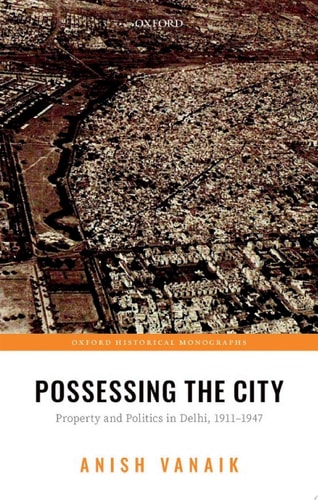
Possessing the City: Property and Politics in Delhi, 1911-1947
0
0
As an Amazon Associate and affiliate partner, Menrva Books earns from qualifying purchases. Learn more
Author Description
Possessing the City is a social history of the property market in late-colonial Delhi; a period of much turbulence and transformation. It argues that historians of South Asian cities must connect transformations in urban space with the economy of the city. Using new archival material, Anish Vanaik outlines the place of private property development in Delhi's economy from 1911 to 1947. Rather than large-scale state initiatives, like the Delhi Improvement Trust, it was profit-oriented, decentralised, and market-based initiatives of urban construction that created the Delhi cityscape. This volume also serves to chart the emerging relationship between the state and urban space in this period. Rather than a narrow focus on urban planning ideas, it argues that the relationship be thought of in a triangular fashion: the intermediation of the property market was crucial to emerging statecraft and urban form in this period. Possessing the City examines struggles and conflicts over the commodification of land, particularly disputes over rents and prices of urban property. The question of commodification can also, however, be discerned in struggles that were not ostensibly about economic issues: clashes over religious sites in the city. Through careful attention to the historical interrelationships between state, space, and the economy in Delhi, this volume offers a novel intervention in the history of late-colonial Delhi.
Menrva's Summary
THE THESIS
How did the interplay between private property markets and statecraft shape the urban development of Delhi during the final decades of British colonial rule? Anish Vanaik, a scholar of South Asian urban history, utilizes previously unexamined archival records to challenge the conventional focus on state-led planning initiatives. He argues that the physical and social landscape of Delhi between 1911 and 1947 was primarily defined by decentralized, profit-driven market activities rather than top-down administrative projects. By mapping the commodification of land, Vanaik demonstrates that the property market acted as a critical intermediary in the evolution of colonial statecraft and urban form.
THE SCOPE MAP
What You Will Find
- Analysis of the Delhi property market from 1911 to 1947.
- Examination of the triangular relationship between the state, the economy, and urban space.
- Case studies on rent disputes, land pricing, and conflicts over religious sites.
Scope Limits
- The study does not focus on large-scale state-led urban planning initiatives like the Delhi Improvement Trust.
- The analysis is geographically confined to the specific urban development of Delhi during the late-colonial period.
THE AUTHORITY PERSPECTIVE
Scholars in the field of South Asian urban studies recognize this work as a significant contribution to understanding the economic drivers of colonial city-building. Readers frequently note the academic density of the prose and the rigorous archival methodology employed by the author.
Page Count:
259
Publication Date:
2019-01-01
Publisher:
OUP Oxford
ISBN-10:
0192588451
ISBN-13:
9780192588456
History
Colonial History
Social History
Asian History
Property
Delhi India
Land tenure
Modern History
Urban Studies
Community Tags
Similar Books