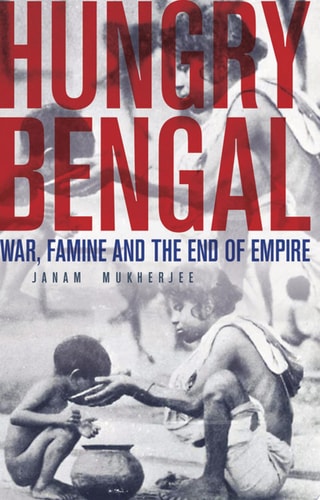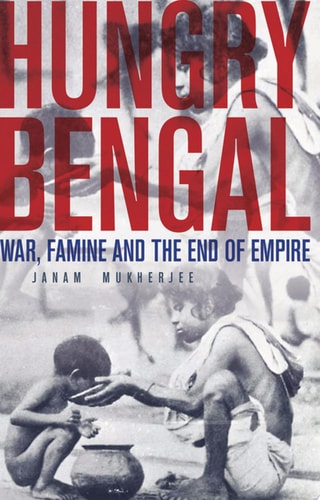
Hungry Bengal: War, Famine and the End of Empire
0
0
As an Amazon Associate and affiliate partner, Menrva Books earns from qualifying purchases. Learn more
Author Description
The years leading up to the independence and accompanying partition of India mark a tumultuous period in the history of Bengal. Representing both a major front in the Indian struggle against colonial rule, as well as a crucial Allied outpost in the British/American war against Japan, Bengal stood at the crossroads of complex and contentious structural forces - both domestic and international - which, taken together, defined an era of political uncertainty, social turmoil and collective violence. While for the British the overarching priority was to save the empire from imminent collapse at any cost, for the majority of the Indian population the 1940s were years of acute scarcity, violent dislocation and enduring calamity. In particular there are three major crises that shaped the social, economic and political context of pre-partition Bengal: the Second World War, the Bengal famine of 1943, and the Calcutta riots of 1946. Hungry Bengal examines these intricately interconnected events, foregrounding the political economy of war and famine in order to analyse the complex nexus of hunger, war and civil violence in colonial Bengal at the twilight of British rule.
Menrva's Summary
THE THESIS
This work investigates the interconnected crises of the Second World War, the 1943 Bengal famine, and the 1946 Calcutta riots to determine how colonial policy and wartime exigencies precipitated the collapse of British rule in India. Janam Mukherjee, a historian specializing in modern South Asian history, utilizes a political economy framework to examine the structural forces that transformed Bengal into a site of acute scarcity and civil violence. The author argues that the British imperial priority of preventing colonial collapse directly exacerbated the suffering of the local population, creating a nexus of hunger and political instability.
THE SCOPE MAP
What You Will Find
- Analysis of the political economy of war and famine in 1940s Bengal
- Examination of the 1943 Bengal famine as a consequence of imperial policy
- Investigation into the 1946 Calcutta riots within the context of pre-partition social turmoil
- Evaluation of the intersection between domestic Indian struggles and international Allied war efforts
Scope Limits
- The text focuses primarily on the political and economic dimensions of the crises rather than providing a comprehensive military history of the region
- The analysis is geographically centered on Bengal and does not provide an exhaustive account of the entire Indian independence movement
THE AUTHORITY PERSPECTIVE
Scholars and historians frequently cite this work for its rigorous integration of economic data with social history to explain the mechanisms of colonial failure. Readers often note the academic density of the prose, which serves as a foundational text for understanding the intersection of global conflict and local humanitarian catastrophe.
Page Count:
329
Publication Date:
2015-01-01
Publisher:
Oxford University Press
ISBN-10:
0190613343
ISBN-13:
9780190613341
History
War
India
Famine
Asia history
Bengal India
Asian History
Colonial History
Famines
Community Tags
Other Editions(2)

Similar Books