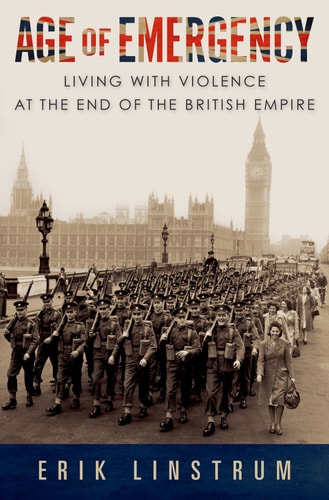
Age of Emergency: Living with Violence at the End of the British Empire
0
0
As an Amazon Associate and affiliate partner, Menrva Books earns from qualifying purchases. Learn more
Author Description
An eye-opening account of how violence was experienced not just on the frontlines of colonial terror but at home in imperial Britain.When uprisings against colonial rule broke out across the world after 1945, Britain responded with overwhelming and brutal force. Although this period has conventionally been dubbed "postwar," it was punctuated by a succession of hard-fought, long-running conflicts that were geographically diffuse, morally ambiguous, and impervious to neat endings or declarations of victory. Ruthless counterinsurgencies in Malaya, Kenya, and Cyprus rippled through British society, molding a home front defined not by the mass mobilization of resources, but by sentiments of uneasiness and the justifications they generated.Age of Emergency traces facts and feelings about violence as torture, summary executions, collective punishments, and other ruthless methods were employed in "states of emergency." It examines how Britons at home learned to live with colonial warfare by examining activist campaigns, soldiers' letters, missionary networks, newspaper stories, television dramas, sermons, novels, and plays. As knowledge of brutality spread, so did the tactics of accommodation aimed at undermining it. Some contemporaries cast doubt on facts about violence. Others stressed the unanticipated consequences of intervening to stop it. Still others aestheticized violence by celebrating visions of racial struggle or dramatizing the grim fatalism of dirty wars. Through their voices, Erik Linstrum narrates what violence looked, heard, and felt like as an empire ended, a history with unsettling echoes in our own time.Vividly analyzing how far-off atrocities became domestic problems, Age of Emergency shows that the compromising entanglements of war extended far beyond the conflict zones of empire.
Menrva's Summary
THE THESIS
This book investigates how the brutal realities of colonial counterinsurgency during the decline of the British Empire were processed, rationalized, and integrated into the domestic consciousness of the British public. Erik Linstrum, a historian specializing in the cultural history of empire, utilizes a wide array of primary sources—ranging from soldiers' correspondence and missionary records to popular media and literature—to argue that the British home front was fundamentally reshaped by the moral and political anxieties of imperial warfare. He demonstrates that the violence occurring in territories like Malaya, Kenya, and Cyprus was not a distant abstraction but a pervasive domestic issue that forced Britons to navigate complex justifications for state-sanctioned brutality.
THE SCOPE MAP
What You Will Find
- Analysis of post-1945 British colonial conflicts in Malaya, Kenya, and Cyprus.
- Examination of diverse cultural artifacts including television dramas, novels, plays, and newspaper reports.
- Investigation into the psychological and social mechanisms used to accommodate or deny reports of torture and collective punishment.
- Documentation of activist campaigns and missionary networks that attempted to challenge imperial narratives.
THE AUTHORITY PERSPECTIVE
Scholars and historians recognize this work as a significant contribution to the study of imperial decline and the domestic reception of colonial violence. Readers frequently note the meticulous archival research and the author's ability to connect distant military atrocities to the evolving social and political climate of postwar Britain.
Page Count:
325
Publication Date:
2023-01-01
Publisher:
Oxford University Press
ISBN-10:
0197572057
ISBN-13:
9780197572054
History
Social History
Colonialism
British History
Modern History
Military History
Community Tags
Other Editions(2)
Similar Books



Reader Comments
Share Your Thoughts
No comments yet. Be the first to share your thoughts!