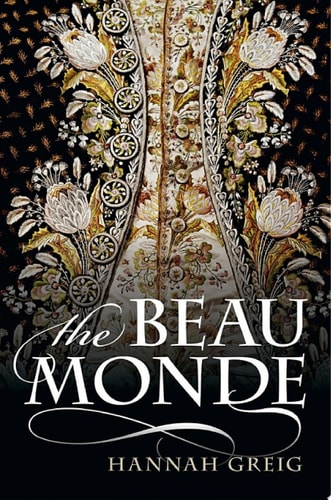
The Beau Monde: Fashionable Society in Georgian London
0
0
As an Amazon Associate and affiliate partner, Menrva Books earns from qualifying purchases. Learn more
Author Description
The story of the world's first fashion-obsessed society in 18th-century London Caricatured for extravagance, vanity, glamorous celebrity and, all too often, embroiled in scandal and gossip, 18th-century London's fashionable society had a well-deserved reputation for frivolity. But to be fashionable in 1700s London meant more than simply being well dressed. Fashion denoted membership of a new type of society--the beau monde, a world where status was no longer determined by coronets and countryseats alone but by the more nebulous qualification of metropolitan 'fashion'. Conspicuous consumption and display were crucial; the right address, the right dinner guests, the right possessions, the right jewels, the right seat at the opera. The Beau Monde leads us on a tour of this exciting new world, from court and parliament to London's parks, pleasure grounds, and private homes. From brash displays of diamond jewellery to the subtle complexities of political intrigue, we see how membership of the new elite was won, maintained--and sometimes lost. On the way, we meet a rich and colourful cast of characters, from the newly ennobled peer learning the ropes and the imposter trying to gain entry by means of clever fakery, to the exile banned for sexual indiscretion. Above all, as the story unfolds, we learn that being a Fashionable was about far more than simply being 'modish'. By the end of the century, it had become nothing less than the key to power and exclusivity in a changed world.
Menrva's Summary
THE THESIS
This work investigates how the concept of 'fashion' evolved from a mere aesthetic preference into a critical mechanism for defining social status and political power in 18th-century London. Hannah Greig, a historian specializing in the social structures of the Georgian era, utilizes a wide array of primary sources including personal correspondence, contemporary newspapers, and legal records to reconstruct the lives of the elite. She argues that the 'beau monde' functioned as a gatekeeping institution where social capital was negotiated through public display, strategic association, and the mastery of metropolitan etiquette.
THE SCOPE MAP
What You Will Find
- Analysis of the social geography of Georgian London, including parks, pleasure grounds, and private residences.
- Examination of the intersection between conspicuous consumption and political influence.
- Profiles of diverse social actors, from established aristocrats to social climbers and imposters.
Scope Limits
- The text focuses primarily on the elite and aspiring elite, providing limited insight into the lives of the laboring classes or those outside the metropolitan sphere.
- It does not provide a comprehensive history of garment manufacturing or textile production techniques.
THE AUTHORITY PERSPECTIVE
Historians and scholars of the Georgian period frequently cite this text for its meticulous archival research and its nuanced understanding of social mobility in the 18th century. Readers often note that the prose is accessible to a general audience while maintaining the academic rigor required for professional historical study.
Page Count:
362
Publication Date:
2013-01-01
Publisher:
OUP Oxford
ISBN-10:
0191664014
ISBN-13:
9780191664014
History
London England
Fashion history
Special Topics
18th century
Great Britain
Modern History
British History
Social History
Community Tags
Similar Books