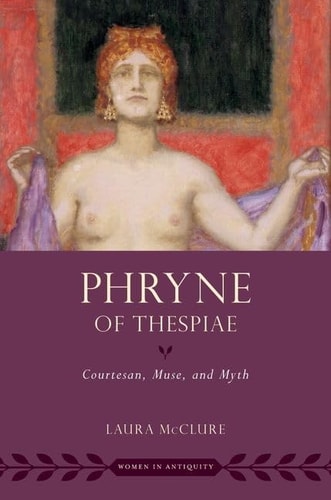
Phryne of Thespiae: Courtesan, Muse, and Myth
0
0
As an Amazon Associate and affiliate partner, Menrva Books earns from qualifying purchases. Learn more
Author Description
Although Phryne is considered the most famous of the many Greek courtesans who flocked to Athens during the fourth century BCE, there have been no modern attempts to reconstruct her life. It was not until the eighteenth century that artistic interest in her developed and her stories were continually reimagined and embellished. Artists and writers have recounted again and again how she served as the model for the Praxiteles' Cnidian Aphrodite, the first monumental female nude in Western art, and how the sight of her naked body won acquittal when she was prosecuted for impiety. However, she left no writings in her own words, and only a handful of fragments related to her have survived from her time. Until now, the primary evidence for her life comes down to us from texts composed hundreds of years after her death, all of them written by men, whose works reflect the changing tastes, experiences, and values of Greeks living under Roman rule.Phryne of Thespiae offers a close analysis of the evidence for sexual labor in classical Athens to find parallels between Phyrne and other Greek courtesans. The result is an innovative biography that examines key moments of Phyrne's life that have been dismissed as male fantasies, arguing that many of them could have plausibly originated in historical events. The portrait that emerges is that of a powerful and socially consequential woman whose wealth and connections helped to shape the society in which she lived.
Menrva's Summary
THE THESIS
This work investigates the historical reality of Phryne of Thespiae, a prominent fourth-century BCE Athenian courtesan whose life has been obscured by centuries of male-authored myth and artistic embellishment. Laura McClure, a scholar of classical literature and women in antiquity, utilizes a critical analysis of surviving fragments and later literary accounts to strip away layers of patriarchal projection. By contextualizing Phryne within the broader framework of sexual labor in classical Athens, the author argues that Phryne was a significant social and economic actor whose influence extended far beyond her role as a muse for artists like Praxiteles.
THE SCOPE MAP
What You Will Find
- A critical examination of the limited primary source fragments regarding fourth-century BCE Athenian courtesans.
- An analysis of the cultural evolution of Phryne’s image from antiquity through the eighteenth century.
- A methodology for distinguishing between historical plausibility and later male-authored fantasy in ancient biographical texts.
- A reconstruction of the social and economic power dynamics available to women in the sex trade of classical Greece.
THE AUTHORITY PERSPECTIVE
Scholars and historians recognize this text as a necessary intervention in classical studies, providing a rigorous framework for evaluating the lives of women who left no written record. Readers frequently note the academic density of the prose, which balances meticulous source criticism with a compelling re-evaluation of ancient gender roles.
Page Count:
214
Publication Date:
2024-08-22
Publisher:
Oxford University Press
ISBN-10:
019758084X
ISBN-13:
9780197580844
History
Biography
Ancient Greece
Women in History
Community & Culture
Historical
Europe
Schools & Teaching
Community Tags
Other Editions(2)
Similar Books