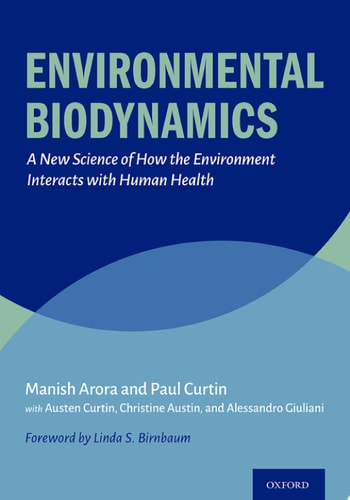
Environmental Biodynamics: A New Science of How the Environment Interacts with Human Health
0
0
As an Amazon Associate and affiliate partner, Menrva Books earns from qualifying purchases. Learn more
Author Description
Is there a central scientific theory governing how human physiology interacts with the environment?Our environment exerts a profound effect on our health and well-being. Yet, the rules guiding such interaction between individual human physiology and the environment remain elusive. While various disciplines have emerged studying components and base interactions of each system, no method has successfully predicted the dynamic behavior between these complex systems in real time.Environmental Biodynamics offers a daring new inquiry into our environment and its impact on human health. Moving beyond a reductionist view of human physiology and the environment, this volume proposes a fundamental shift in environmental health science from quantifying structural relationships, such as static measures of environmental factors or momentary health indicators, to studying functional interdependencies in time. Across six chapters, the authors weave together the latest research from biology, environmental science, theoretical physics, mathematics, and philosophy to explore their Biodynamic Interface Theory, which states that complex systems connect primarily through a dynamic, operationally independent interface that regulates the bidirectional interactions between systems over time. Later chapters compare the proposed theory against current practice and provide suggestions for further methods of data collection and computational analysis. Supported by vivid full-color diagrams and a wealth of original data, Environmental Biodynamics is an accessible theoretical guide to this promising new field of environmental health
Menrva's Summary
THE THESIS
This book investigates whether a central scientific theory exists to explain the complex, real-time interactions between human physiology and the environment. Authors Manish Kumar Arora and Paul C. P. Curtin challenge the traditional reductionist approach to environmental health by proposing a shift toward studying functional interdependencies over time. They introduce the Biodynamic Interface Theory, a framework that posits complex systems connect through an operationally independent interface that regulates bidirectional interactions. By synthesizing research from mathematics, theoretical physics, and biology, the authors provide a new conceptual model for predicting how environmental factors influence human health.
THE SCOPE MAP
What You Will Find
- The Biodynamic Interface Theory framework for analyzing system interdependencies.
- A critique of current static measurement practices in environmental health science.
- Integration of methodologies from theoretical physics, mathematics, and biology.
- Proposals for advanced data collection and computational analysis techniques.
THE AUTHORITY PERSPECTIVE
Experts view this work as a theoretical contribution to the field of environmental health, offering a novel perspective on systems biology. Readers frequently note the interdisciplinary density of the prose, which requires a foundational understanding of both biological and physical sciences to fully grasp the proposed theoretical model.
Page Count:
160
Publication Date:
2021-12-14
Publisher:
Oxford University Press
ISBN-10:
019758294X
ISBN-13:
9780197582947
Health
Science
Philosophy
Physics
Kindle eBooks
Kindle Store
Biology
Categories
Community Tags
Similar Books