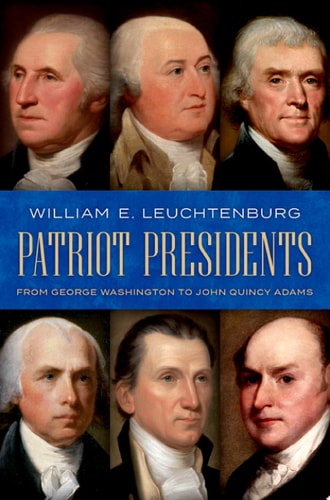
Patriot Presidents: From George Washington to John Quincy Adams
0
0
As an Amazon Associate and affiliate partner, Menrva Books earns from qualifying purchases. Learn more
Author Description
A nuanced account of the early leaders who shaped the American presidencyThe founding fathers of the United States created a unique institution, the presidency, as they were determined to authorize an effective chief executive but wary of monarchy. They endowed this office with broad prerogatives and power but hedged it in with limitations. The presidency that developed over the next generation, however, was fashioned less by the clauses in the Constitution than by the way that the first presidents responded to challenges such as sectional enmity and the vexing Napoleonic warfare that jeopardized maritime rights.Patriot Presidents explores how the presidency took shape from the medley of clauses handed down to George Washington, who said, "I walk on untrodden ground," for virtually everything he did created a precedent. It then follows the overwhelming challenges faced by his successors, from the austere John Adams who spoke passionately in favor of a strong executive, to Thomas Jefferson, a zealous advocate of American liberties, to James Madison, the creator of the first political party, and James Monroe, whose Monroe Doctrine protected the sovereignty of the Western Hemisphere. It concludes with John Quincy Adams, who could be called the prophet of the expansive twentieth-century state of the Square Deal, the New Deal, the Fair Deal, and the Great Society.The esteemed American historian William E. Leuchtenburg invites readers to revisit the years after the birth of the republic, when Americans could take pride in leaders of ideals, high competence, and integrity who headed their government--chief executives who, though not unflawed, had an abiding commitment to the success of the vulnerable government that had emerged from the revolutionary cause to which they had devoted themselves.
Menrva's Summary
THE THESIS
This work investigates how the early American presidents navigated the tension between executive authority and the fear of monarchical power to define the office of the presidency. William E. Leuchtenburg, a distinguished historian of the American presidency, utilizes primary source documents and historical analysis to examine the formative years of the executive branch. He argues that the institution was shaped less by constitutional text than by the practical responses of the first six presidents to internal sectionalism and external geopolitical threats. The book provides a framework for understanding how these leaders established the precedents that continue to define the modern executive role.
THE SCOPE MAP
What You Will Find
- Analysis of the constitutional origins and limitations of the American presidency.
- Historical examination of the first six presidents from George Washington to John Quincy Adams.
- Evaluation of how early executive responses to Napoleonic warfare and sectional conflict established long-term precedents.
- Discussion of the evolution of political parties and the expansion of federal authority.
THE AUTHORITY PERSPECTIVE
Historians and scholars recognize this work as a clear and accessible examination of the early republic's executive leadership. Readers frequently note the author's ability to synthesize complex political history into a cohesive narrative that highlights the personal integrity and challenges of the founding generation.
Page Count:
240
Publication Date:
2024-07-29
Publisher:
Oxford University Press
ISBN-10:
0197598854
ISBN-13:
9780197598856
Politics
History
Biography
Presidency
Criminal Law
American History
Specific Topics
Law Enforcement
Americas
Community Tags
Other Editions(2)
Similar Books










Reader Comments
Share Your Thoughts
No comments yet. Be the first to share your thoughts!