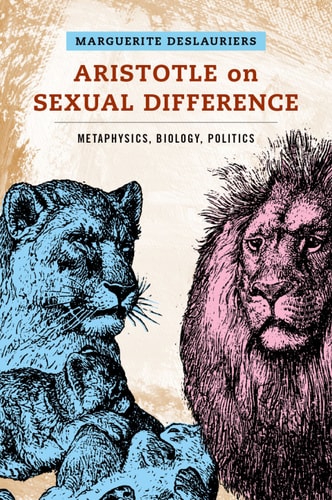
Aristotle on Sexual Difference: Metaphysics, Biology, Politics
0
0
As an Amazon Associate and affiliate partner, Menrva Books earns from qualifying purchases. Learn more
Author Description
Aristotle's remarks about the differences between the sexes have become infamous for their implications for the social status of women. In his observations on female biology, Aristotle claims that "the female nature is, as it were, a deformity." In describing women's role in the public sphere, he claims that women are naturally subordinate because, while they possess a deliberative faculty, that capacity is "without authority." While both claims express the "inferiority" of female bodies/women relative to male bodies/men, it is not self-evident that the defects Aristotle identifies in female biology have cognitive or moral manifestations that would justify the rule of men over women in political life. Marguerite Deslauriers here aims to construct a coherent picture of Aristotle's views on sexual and gender-based difference from these remarks and to show the extent to which his views on female biology and women's role in politics are causally connected. Without exculpating Aristotle from charges of misogyny, Deslauriers contextualizes his explanations of the role and origin of female animals in his biology and the role of women in his political philosophy; she shows how Aristotle developed these views and the importance they hold for his wider philosophical commitments. She then explores how Aristotle might have seen the link between the physiology of sex and the bearing it has on political life. She ultimately argues that in Aristotle's conception of sexual difference in biology and politics, there is a tension between his view of the inferiority of female bodies and women and his commitment to the idea that females and women are valuable both for generation and for the political life characteristic of human beings. In this tension she finds a difference between Aristotle and his predecessors: while previous accounts associate sexual difference with affliction, Aristotle sees sexual difference as a benefit, both to a species and a political community.
Menrva's Summary
THE THESIS
Does Aristotle's biological characterization of female inferiority necessitate his political exclusion of women, or is there a deeper, more complex philosophical tension in his work? Marguerite Deslauriers, a scholar of ancient philosophy, examines the intersection of Aristotle's biological observations and his political theory. By analyzing key texts where Aristotle addresses sexual difference, she argues that his work contains a fundamental conflict between the perceived inferiority of the female body and the essential value he assigns to women within both biological generation and the political community.
THE SCOPE MAP
What You Will Find
- Analysis of Aristotle's biological claims regarding female nature and deformity.
- Investigation into the political status of women and the deliberative faculty.
- Examination of the causal links between physiological sex and political authority.
- Comparative study of Aristotle's views against those of his philosophical predecessors.
THE AUTHORITY PERSPECTIVE
Scholars recognize this work as a rigorous contribution to the study of Aristotelian philosophy, particularly regarding the intersection of his biology and political theory. The text is noted for its nuanced approach to historical misogyny while maintaining a high level of academic precision in its philosophical analysis.
Page Count:
372
Publication Date:
2022-01-01
Publisher:
Oxford University Press
ISBN-10:
0197606202
ISBN-13:
9780197606209
Philosophy
History
Gender Studies
Biology
History & Surveys
Community Tags
Similar Books