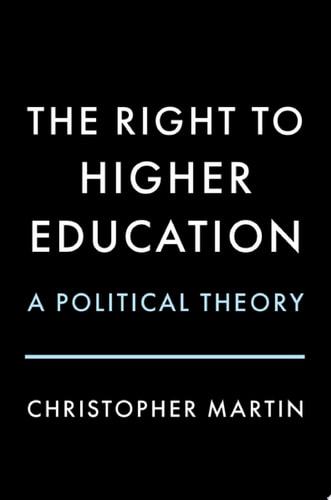
The Right to Higher Education: A Political Theory
0
0
As an Amazon Associate and affiliate partner, Menrva Books earns from qualifying purchases. Learn more
Author Description
Many assume that a person's right to education terminates with high school, and that higher education is a luxury addition. The conversation about education changes in palpable ways once we focus on higher education rather than the education we ordinarily think that citizens are due when they are children and teenagers. We see more talk about competition for university places, standardized testing, and elite admissions. We parse out the differences between the benefits of education for the individual and the burdens of public financial support for such an education. The move from educational provision for children to educational provision for adults marks a troubling transformation in this public conversation: from one about how it can improve the lives of all individuals, to one preoccupied with fairness, competition, merit, personal responsibility, and the sharing of benefits and burdens. Problems of status, stratification, and selectivity capture as much, if not more, of our attention than the question of what higher education institutions should aim to achieve. But why should it be so different, when it is no less essential? Obtaining a higher education degree can change the course of a person's life, providing them with vast opportunities that they could not access otherwise--in fact for many it is a prerequisite for fulfilling their personal and professional goals, or even being able to just make a living. Yet it is almost always framed as privilege, not a right--and a privilege many spend years or even decades paying for after their studies have ended. Our higher education systems are built on the presumption that this is all as it should be: that pursuing higher education is a choice some people make, but not something to which all of us are entitled. Christopher Martin turns this view on its head by arguing that higher education is in fact an unconditional, absolute right of all citizens in a free and open society. As he argues, a closer look at the value o
Menrva's Summary
THE THESIS
Does the current framing of higher education as a privilege rather than a fundamental right undermine the principles of a free and open society? Christopher J. Martin, a scholar in the philosophy of education, challenges the prevailing neoliberal consensus that treats university access as a competitive meritocratic reward. By synthesizing political theory with educational policy, he argues that the state has a moral obligation to provide higher education as an unconditional entitlement to all citizens, rather than a luxury good subject to market forces.
THE SCOPE MAP
What You Will Find
- A critique of meritocracy and status-based stratification in university admissions.
- An analysis of the shift from childhood educational rights to adult educational provision.
- A philosophical framework for defining higher education as a prerequisite for personal and professional autonomy.
- An examination of the economic and social burdens placed on individuals within current higher education systems.
THE AUTHORITY PERSPECTIVE
Scholars in the field of educational philosophy recognize this work as a significant contribution to the debate on social justice and institutional access. Readers frequently note the rigorous logical structure Martin employs to dismantle the common assumption that higher education is merely a private choice.
Page Count:
266
Publication Date:
2021-01-01
Publisher:
Oxford University Press
ISBN-10:
0197612938
ISBN-13:
9780197612934
Philosophy
Educational Foundations
Higher
Public Policy
Professional Career & Trade
Education
Sociology
Community Tags
Similar Books