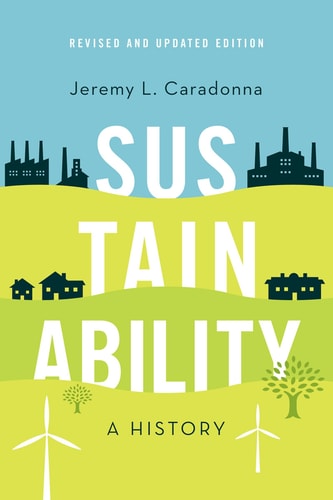
Sustainability: A History
0
0
As an Amazon Associate and affiliate partner, Menrva Books earns from qualifying purchases. Learn more
Author Description
From one of the world's leading experts on the subject, a fully updated introduction to the sustainability movement from the 1600s to today. The word is nearly ubiquitous: at the grocery store we shop for "sustainable foods" that were produced from "sustainable agriculture"; groups ranging from small advocacy organizations to city and state governments to the United Nations tout "sustainable development" as a strategy for local and global stability; and woe betide the city-dweller who doesn't aim for a "sustainable lifestyle." Seeming to have come out of nowhere to dominate the discussion-from permaculture to renewable energy to the local food movement-the ideas that underlie and define sustainability can be traced back several centuries. In this illuminating and fascinating primer, newly revised and updated, Jeremy L. Caradonna does just that, approaching sustainability from a historical perspective and revealing the conditions that gave it shape. Locating the underpinnings of the movement as far back as the 1660s, Caradonna considers the origins of sustainability across many fields throughout Europe and North America. Taking us from the emergence of thoughts guiding sustainable yield forestry in the late 17th and 18th centuries, through the challenges of the Industrial Revolution, the birth of the environmental movement, and the emergence of a concrete effort to promote a balanced approach to development in the latter half of the 20th century, he shows that while sustainability draws upon ideas of social justice, ecological economics, and environmental conservation, it is more than the sum of its parts and blends these ideas together into a dynamic philosophy. Caradonna's book broadens our understanding of what "sustainability" means, revealing how it progressed from a relatively marginal concept to an ideal that shapes everything from individual lifestyles, government and corporate strategies, and even national and international policy.
Menrva's Summary
THE THESIS
This book investigates the historical origins and evolution of the concept of sustainability, tracing its development from 17th-century forestry practices to its current status as a global policy framework. Jeremy L. Caradonna, an expert in environmental history, utilizes a chronological analysis to demonstrate how sustainability emerged as a synthesis of ecological economics, social justice, and conservation. By examining the shift from marginal intellectual discourse to a dominant modern philosophy, the author provides a structured account of how human societies have attempted to balance resource extraction with long-term stability. The text argues that understanding these historical roots is necessary to grasp the complexities of contemporary environmental challenges.
THE SCOPE MAP
What You Will Find
- Historical analysis of sustainable yield forestry beginning in the 1660s.
- Examination of the impact of the Industrial Revolution on resource management.
- Evaluation of the 20th-century environmental movement and the rise of sustainable development.
- Synthesis of diverse intellectual traditions including ecological economics and social justice.
THE AUTHORITY PERSPECTIVE
Experts recognize this work as a foundational historical primer that successfully contextualizes modern environmental buzzwords within a broader timeline. Readers frequently note the clarity of the prose, which makes complex intellectual history accessible to both students and general audiences interested in policy and environmental studies.
Page Count:
344
Publication Date:
2022-06-03
Publisher:
Oxford University Press
ISBN-10:
0197625037
ISBN-13:
9780197625033
Politics
History
Sustainability
Social Science
Community Tags
Other Editions(3)
Similar Books








Reader Comments
Share Your Thoughts
No comments yet. Be the first to share your thoughts!