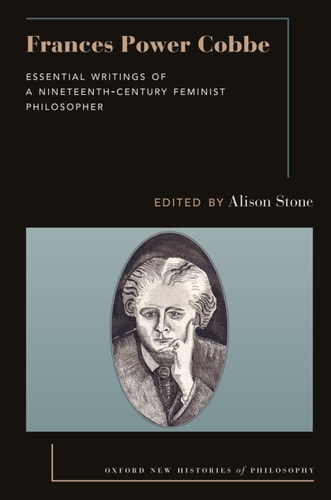
Frances Power Cobbe: Essential Writings of a Nineteenth-Century Feminist Philosopher
0
0
As an Amazon Associate and affiliate partner, Menrva Books earns from qualifying purchases. Learn more
Author Description
This volume brings together essential writings by the unjustly neglected nineteenth-century philosopher Frances Power Cobbe (1822-1904). A prominent ethicist, feminist, champion of animal welfare, and critic of Darwinism and atheism, Cobbe was well known and highly regarded in the Victorian era. This collection of her work introduces contemporary readers to Cobbe and shows how her thought developed over time, beginning in 1855 with her Essay on Intuitive Morals, in which she set out her duty-based moral theory, arguing that morality and religion are indissolubly connected. This work provided the framework within which she addressed many theoretical and practical issues in her prolific publishing career. In the 1860s and early 1870s, she gave an account of human duties to animals; articulated a duty-based form of feminism; defended a unique type of dualism in the philosophy of mind; and argued against evolutionary ethics. Cobbe put her philosophical views into practice, campaigning for women's rights and for first the regulation and later the abolition of vivisection. In turn her political experiences led her to revise her ethical theory. From the 1870s onwards she increasingly emphasized the moral role of the emotions, especially sympathy, and she theorized a gradual historical progression in sympathy. Moving into the 1880s, Cobbe combatted secularism, agnosticism, and atheism, arguing that religion is necessary not only for morality but also for meaningful life and culture. Shedding light on Cobbe's philosophical perspective and its applications, this volume demonstrates the range, systematicity and philosophical character of her work and makes her core ethical theory and its central applications and developments available for teaching and scholarship.
Menrva's Summary
THE THESIS
This volume investigates the philosophical contributions of Frances Power Cobbe, a prominent nineteenth-century thinker whose work bridged ethics, feminism, and animal welfare. Alison Stone, a scholar of nineteenth-century philosophy, curates this collection to demonstrate the systematic nature of Cobbe's thought. The book argues that Cobbe's duty-based moral theory, rooted in the connection between religion and morality, served as the foundation for her later activism and critiques of evolutionary ethics and secularism.
THE SCOPE MAP
What You Will Find
- A chronological selection of Cobbe's primary writings from 1855 to the 1880s.
- Analysis of her duty-based moral theory and its evolution regarding human emotions and sympathy.
- Critical examination of her stance on feminism, animal rights, and the critique of Darwinism.
- Contextual introductions that link her theoretical work to her practical political campaigns.
THE AUTHORITY PERSPECTIVE
Scholars and historians of philosophy identify this volume as a significant effort to restore Cobbe to her rightful place within the Victorian intellectual canon. Readers frequently note the clarity of the editorial framing, which effectively bridges the gap between her abstract ethical theories and her active public life.
Page Count:
426
Publication Date:
2022-01-01
Publisher:
Oxford University Press
ISBN-10:
0197628257
ISBN-13:
9780197628256
History
Biography
Philosophy
Religion
Feminist Theory
Ethics
Womens Studies
Modern History
Victorian History
Feminism
Community Tags
Similar Books